Wednesday, July 19, 2006

francis beedle told me to read...


George Washington's Farewell Address 1796

Friends and Citizens:

The period for a new election of a citizen to administer the executive government of the United States being not far distant, and the time actually arrived when your thoughts must be employed in designating the person who is to be clothed with that important trust, it appears to me proper, especially as it may conduce to a more distinct expression of the public voice, that I should now apprise you of the resolution I have formed, to decline being considered among the number of those out of whom a choice is to be made.

I beg you, at the same time, to do me the justice to be assured that this resolution has not been taken without a strict regard to all the considerations appertaining to the relation which binds a dutiful citizen to his country; and that in withdrawing the tender of service, which silence in my situation might imply, I am influenced by no diminution of zeal for your future interest, no deficiency of grateful respect for your past kindness, but am supported by a full conviction that the step is compatible with both.

The acceptance of, and continuance hitherto in, the office to which your suffrages have twice called me have been a uniform sacrifice of inclination to the opinion of duty and to a deference for what appeared to be your desire. I constantly hoped that it would have been much earlier in my power, consistently with motives which I was not at liberty to disregard, to return to that retirement from which I had been reluctantly drawn. The strength of my inclination to do this, previous to the last election, had even led to the preparation of an address to declare it to you; but mature reflection on the then perplexed and critical posture of our affairs with foreign nations, and the unanimous advice of persons entitled to my confidence, impelled me to abandon the idea.

I rejoice that the state of your concerns, external as well as internal, no longer renders the pursuit of inclination incompatible with the sentiment of duty or propriety, and am persuaded, whatever partiality may be retained for my services, that, in the present circumstances of our country, you will not disapprove my determination to retire.

The impressions with which I first undertook the arduous trust were explained on the proper occasion. In the discharge of this trust, I will only say that I have, with good intentions, contributed towards the organization and administration of the government the best exertions of which a very fallible judgment was capable. Not unconscious in the outset of the inferiority of my qualifications, experience in my own eyes, perhaps still more in the eyes of others, has strengthened the motives to diffidence of myself; and every day the increasing weight of years admonishes me more and more that the shade of retirement is as necessary to me as it will be welcome. Satisfied that if any circumstances have given peculiar value to my services, they were temporary, I have the consolation to believe that, while choice and prudence invite me to quit the political scene, patriotism does not forbid it.

In looking forward to the moment which is intended to terminate the career of my public life, my feelings do not permit me to suspend the deep acknowledgment of that debt of gratitude which I owe to my beloved country for the many honors it has conferred upon me; still more for the steadfast confidence with which it has supported me; and for the opportunities I have thence enjoyed of manifesting my inviolable attachment, by services faithful and persevering, though in usefulness unequal to my zeal. If benefits have resulted to our country from these services, let it always be remembered to your praise, and as an instructive example in our annals, that under circumstances in which the passions, agitated in every direction, were liable to mislead, amidst appearances sometimes dubious, vicissitudes of fortune often discouraging, in situations in which not unfrequently want of success has countenanced the spirit of criticism, the constancy of your support was the essential prop of the efforts, and a guarantee of the plans by which they were effected. Profoundly penetrated with this idea, I shall carry it with me to my grave, as a strong incitement to unceasing vows that heaven may continue to you the choicest tokens of its beneficence; that your union and brotherly affection may be perpetual; that the free Constitution, which is the work of your hands, may be sacredly maintained; that its administration in every department may be stamped with wisdom and virtue; that, in fine, the happiness of the people of these States, under the auspices of liberty, may be made complete by so careful a preservation and so prudent a use of this blessing as will acquire to them the glory of recommending it to the applause, the affection, and adoption of every nation which is yet a stranger to it.

Here, perhaps, I ought to stop. But a solicitude for your welfare, which cannot end but with my life, and the apprehension of danger, natural to that solicitude, urge me, on an occasion like the present, to offer to your solemn contemplation, and to recommend to your frequent review, some sentiments which are the result of much reflection, of no inconsiderable observation, and which appear to me all-important to the permanency of your felicity as a people. These will be offered to you with the more freedom, as you can only see in them the disinterested warnings of a parting friend, who can possibly have no personal motive to bias his counsel. Nor can I forget, as an encouragement to it, your indulgent reception of my sentiments on a former and not dissimilar occasion.

Interwoven as is the love of liberty with every ligament of your hearts, no recommendation of mine is necessary to fortify or confirm the attachment.

The unity of government which constitutes you one people is also now dear to you. It is justly so, for it is a main pillar in the edifice of your real independence, the support of your tranquility at home, your peace abroad; of your safety; of your prosperity; of that very liberty which you so highly prize. But as it is easy to foresee that, from different causes and from different quarters, much pains will be taken, many artifices employed to weaken in your minds the conviction of this truth; as this is the point in your political fortress against which the batteries of internal and external enemies will be most constantly and actively (though often covertly and insidiously) directed, it is of infinite moment that you should properly estimate the immense value of your national union to your collective and individual happiness; that you should cherish a cordial, habitual, and immovable attachment to it; accustoming yourselves to think and speak of it as of the palladium of your political safety and prosperity; watching for its preservation with jealous anxiety; discountenancing whatever may suggest even a suspicion that it can in any event be abandoned; and indignantly frowning upon the first dawning of every attempt to alienate any portion of our country from the rest, or to enfeeble the sacred ties which now link together the various parts.

For this you have every inducement of sympathy and interest. Citizens, by birth or choice, of a common country, that country has a right to concentrate your affections. The name of American, which belongs to you in your national capacity, must always exalt the just pride of patriotism more than any appellation derived from local discriminations. With slight shades of difference, you have the same religion, manners, habits, and political principles. You have in a common cause fought and triumphed together; the independence and liberty you possess are the work of joint counsels, and joint efforts of common dangers, sufferings, and successes.

But these considerations, however powerfully they address themselves to your sensibility, are greatly outweighed by those which apply more immediately to your interest. Here every portion of our country finds the most commanding motives for carefully guarding and preserving the union of the whole.

The North, in an unrestrained intercourse with the South, protected by the equal laws of a common government, finds in the productions of the latter great additional resources of maritime and commercial enterprise and precious materials of manufacturing industry. The South, in the same intercourse, benefiting by the agency of the North, sees its agriculture grow and its commerce expand. Turning partly into its own channels the seamen of the North, it finds its particular navigation invigorated; and, while it contributes, in different ways, to nourish and increase the general mass of the national navigation, it looks forward to the protection of a maritime strength, to which itself is unequally adapted. The East, in a like intercourse with the West, already finds, and in the progressive improvement of interior communications by land and water, will more and more find a valuable vent for the commodities which it brings from abroad, or manufactures at home. The West derives from the East supplies requisite to its growth and comfort, and, what is perhaps of still greater consequence, it must of necessity owe the secure enjoyment of indispensable outlets for its own productions to the weight, influence, and the future maritime strength of the Atlantic side of the Union, directed by an indissoluble community of interest as one nation. Any other tenure by which the West can hold this essential advantage, whether derived from its own separate strength, or from an apostate and unnatural connection with any foreign power, must be intrinsically precarious.

While, then, every part of our country thus feels an immediate and particular interest in union, all the parts combined cannot fail to find in the united mass of means and efforts greater strength, greater resource, proportionably greater security from external danger, a less frequent interruption of their peace by foreign nations; and, what is of inestimable value, they must derive from union an exemption from those broils and wars between themselves, which so frequently afflict neighboring countries not tied together by the same governments, which their own rival ships alone would be sufficient to produce, but which opposite foreign alliances, attachments, and intrigues would stimulate and embitter. Hence, likewise, they will avoid the necessity of those overgrown military establishments which, under any form of government, are inauspicious to liberty, and which are to be regarded as particularly hostile to republican liberty. In this sense it is that your union ought to be considered as a main prop of your liberty, and that the love of the one ought to endear to you the preservation of the other.

These considerations speak a persuasive language to every reflecting and virtuous mind, and exhibit the continuance of the Union as a primary object of patriotic desire. Is there a doubt whether a common government can embrace so large a sphere? Let experience solve it. To listen to mere speculation in such a case were criminal. We are authorized to hope that a proper organization of the whole with the auxiliary agency of governments for the respective subdivisions, will afford a happy issue to the experiment. It is well worth a fair and full experiment. With such powerful and obvious motives to union, affecting all parts of our country, while experience shall not have demonstrated its impracticability, there will always be reason to distrust the patriotism of those who in any quarter may endeavor to weaken its bands.

In contemplating the causes which may disturb our Union, it occurs as matter of serious concern that any ground should have been furnished for characterizing parties by geographical discriminations, Northern and Southern, Atlantic and Western; whence designing men may endeavor to excite a belief that there is a real difference of local interests and views. One of the expedients of party to acquire influence within particular districts is to misrepresent the opinions and aims of other districts. You cannot shield yourselves too much against the jealousies and heartburnings which spring from these misrepresentations; they tend to render alien to each other those who ought to be bound together by fraternal affection. The inhabitants of our Western country have lately had a useful lesson on this head; they have seen, in the negotiation by the Executive, and in the unanimous ratification by the Senate, of the treaty with Spain, and in the universal satisfaction at that event, throughout the United States, a decisive proof how unfounded were the suspicions propagated among them of a policy in the General Government and in the Atlantic States unfriendly to their interests in regard to the Mississippi; they have been witnesses to the formation of two treaties, that with Great Britain, and that with Spain, which secure to them everything they could desire, in respect to our foreign relations, towards confirming their prosperity. Will it not be their wisdom to rely for the preservation of these advantages on the Union by which they were procured ? Will they not henceforth be deaf to those advisers, if such there are, who would sever them from their brethren and connect them with aliens?

To the efficacy and permanency of your Union, a government for the whole is indispensable. No alliance, however strict, between the parts can be an adequate substitute; they must inevitably experience the infractions and interruptions which all alliances in all times have experienced. Sensible of this momentous truth, you have improved upon your first essay, by the adoption of a constitution of government better calculated than your former for an intimate union, and for the efficacious management of your common concerns. This government, the offspring of our own choice, uninfluenced and unawed, adopted upon full investigation and mature deliberation, completely free in its principles, in the distribution of its powers, uniting security with energy, and containing within itself a provision for its own amendment, has a just claim to your confidence and your support. Respect for its authority, compliance with its laws, acquiescence in its measures, are duties enjoined by the fundamental maxims of true liberty. The basis of our political systems is the right of the people to make and to alter their constitutions of government. But the Constitution which at any time exists, till changed by an explicit and authentic act of the whole people, is sacredly obligatory upon all. The very idea of the power and the right of the people to establish government presupposes the duty of every individual to obey the established government.

All obstructions to the execution of the laws, all combinations and associations, under whatever plausible character, with the real design to direct, control, counteract, or awe the regular deliberation and action of the constituted authorities, are destructive of this fundamental principle, and of fatal tendency. They serve to organize faction, to give it an artificial and extraordinary force; to put, in the place of the delegated will of the nation the will of a party, often a small but artful and enterprising minority of the community; and, according to the alternate triumphs of different parties, to make the public administration the mirror of the ill-concerted and incongruous projects of faction, rather than the organ of consistent and wholesome plans digested by common counsels and modified by mutual interests.

However combinations or associations of the above description may now and then answer popular ends, they are likely, in the course of time and things, to become potent engines, by which cunning, ambitious, and unprincipled men will be enabled to subvert the power of the people and to usurp for themselves the reins of government, destroying afterwards the very engines which have lifted them to unjust dominion.

Towards the preservation of your government, and the permanency of your present happy state, it is requisite, not only that you steadily discountenance irregular oppositions to its acknowledged authority, but also that you resist with care the spirit of innovation upon its principles, however specious the pretexts. One method of assault may be to effect, in the forms of the Constitution, alterations which will impair the energy of the system, and thus to undermine what cannot be directly overthrown. In all the changes to which you may be invited, remember that time and habit are at least as necessary to fix the true character of governments as of other human institutions; that experience is the surest standard by which to test the real tendency of the existing constitution of a country; that facility in changes, upon the credit of mere hypothesis and opinion, exposes to perpetual change, from the endless variety of hypothesis and opinion; and remember, especially, that for the efficient management of your common interests, in a country so extensive as ours, a government of as much vigor as is consistent with the perfect security of liberty is indispensable. Liberty itself will find in such a government, with powers properly distributed and adjusted, its surest guardian. It is, indeed, little else than a name, where the government is too feeble to withstand the enterprises of faction, to confine each member of the society within the limits prescribed by the laws, and to maintain all in the secure and tranquil enjoyment of the rights of person and property.

I have already intimated to you the danger of parties in the State, with particular reference to the founding of them on geographical discriminations. Let me now take a more comprehensive view, and warn you in the most solemn manner against the baneful effects of the spirit of party generally.

This spirit, unfortunately, is inseparable from our nature, having its root in the strongest passions of the human mind. It exists under different shapes in all governments, more or less stifled, controlled, or repressed; but, in those of the popular form, it is seen in its greatest rankness, and is truly their worst enemy.

The alternate domination of one faction over another, sharpened by the spirit of revenge, natural to party dissension, which in different ages and countries has perpetrated the most horrid enormities, is itself a frightful despotism. But this leads at length to a more formal and permanent despotism. The disorders and miseries which result gradually incline the minds of men to seek security and repose in the absolute power of an individual; and sooner or later the chief of some prevailing faction, more able or more fortunate than his competitors, turns this disposition to the purposes of his own elevation, on the ruins of public liberty.

Without looking forward to an extremity of this kind (which nevertheless ought not to be entirely out of sight), the common and continual mischiefs of the spirit of party are sufficient to make it the interest and duty of a wise people to discourage and restrain it.

It serves always to distract the public councils and enfeeble the public administration. It agitates the community with ill-founded jealousies and false alarms, kindles the animosity of one part against another, foments occasionally riot and insurrection. It opens the door to foreign influence and corruption, which finds a facilitated access to the government itself through the channels of party passions. Thus the policy and the will of one country are subjected to the policy and will of another.

There is an opinion that parties in free countries are useful checks upon the administration of the government and serve to keep alive the spirit of liberty. This within certain limits is probably true; and in governments of a monarchical cast, patriotism may look with indulgence, if not with favor, upon the spirit of party. But in those of the popular character, in governments purely elective, it is a spirit not to be encouraged. From their natural tendency, it is certain there will always be enough of that spirit for every salutary purpose. And there being constant danger of excess, the effort ought to be by force of public opinion, to mitigate and assuage it. A fire not to be quenched, it demands a uniform vigilance to prevent its bursting into a flame, lest, instead of warming, it should consume.

It is important, likewise, that the habits of thinking in a free country should inspire caution in those entrusted with its administration, to confine themselves within their respective constitutional spheres, avoiding in the exercise of the powers of one department to encroach upon another. The spirit of encroachment tends to consolidate the powers of all the departments in one, and thus to create, whatever the form of government, a real despotism. A just estimate of that love of power, and proneness to abuse it, which predominates in the human heart, is sufficient to satisfy us of the truth of this position. The necessity of reciprocal checks in the exercise of political power, by dividing and distributing it into different depositaries, and constituting each the guardian of the public weal against invasions by the others, has been evinced by experiments ancient and modern; some of them in our country and under our own eyes. To preserve them must be as necessary as to institute them. If, in the opinion of the people, the distribution or modification of the constitutional powers be in any particular wrong, let it be corrected by an amendment in the way which the Constitution designates. But let there be no change by usurpation; for though this, in one instance, may be the instrument of good, it is the customary weapon by which free governments are destroyed. The precedent must always greatly overbalance in permanent evil any partial or transient benefit, which the use can at any time yield.

Of all the dispositions and habits which lead to political prosperity, religion and morality are indispensable supports. In vain would that man claim the tribute of patriotism, who should labor to subvert these great pillars of human happiness, these firmest props of the duties of men and citizens. The mere politician, equally with the pious man, ought to respect and to cherish them. A volume could not trace all their connections with private and public felicity. Let it simply be asked: Where is the security for property, for reputation, for life, if the sense of religious obligation desert the oaths which are the instruments of investigation in courts of justice ? And let us with caution indulge the supposition that morality can be maintained without religion. Whatever may be conceded to the influence of refined education on minds of peculiar structure, reason and experience both forbid us to expect that national morality can prevail in exclusion of religious principle.

It is substantially true that virtue or morality is a necessary spring of popular government. The rule, indeed, extends with more or less force to every species of free government. Who that is a sincere friend to it can look with indifference upon attempts to shake the foundation of the fabric?

Promote then, as an object of primary importance, institutions for the general diffusion of knowledge. In proportion as the structure of a government gives force to public opinion, it is essential that public opinion should be enlightened.

As a very important source of strength and security, cherish public credit. One method of preserving it is to use it as sparingly as possible, avoiding occasions of expense by cultivating peace, but remembering also that timely disbursements to prepare for danger frequently prevent much greater disbursements to repel it, avoiding likewise the accumulation of debt, not only by shunning occasions of expense, but by vigorous exertion in time of peace to discharge the debts which unavoidable wars may have occasioned, not ungenerously throwing upon posterity the burden which we ourselves ought to bear. The execution of these maxims belongs to your representatives, but it is necessary that public opinion should co-operate. To facilitate to them the performance of their duty, it is essential that you should practically bear in mind that towards the payment of debts there must be revenue; that to have revenue there must be taxes; that no taxes can be devised which are not more or less inconvenient and unpleasant; that the intrinsic embarrassment, inseparable from the selection of the proper objects (which is always a choice of difficulties), ought to be a decisive motive for a candid construction of the conduct of the government in making it, and for a spirit of acquiescence in the measures for obtaining revenue, which the public exigencies may at any time dictate.

Observe good faith and justice towards all nations; cultivate peace and harmony with all. Religion and morality enjoin this conduct; and can it be, that good policy does not equally enjoin it 7 It will be worthy of a free, enlightened, and at no distant period, a great nation, to give to mankind the magnanimous and too novel example of a people always guided by an exalted justice and benevolence. Who can doubt that, in the course of time and things, the fruits of such a plan would richly repay any temporary advantages which might be lost by a steady adherence to it ? Can it be that Providence has not connected the permanent felicity of a nation with its virtue ? The experiment, at least, is recommended by every sentiment which ennobles human nature. Alas! is it rendered impossible by its vices?

In the execution of such a plan, nothing is more essential than that permanent, inveterate antipathies against particular nations, and passionate attachments for others, should be excluded; and that, in place of them, just and amicable feelings towards all should be cultivated. The nation which indulges towards another a habitual hatred or a habitual fondness is in some degree a slave. It is a slave to its animosity or to its affection, either of which is sufficient to lead it astray from its duty and its interest. Antipathy in one nation against another disposes each more readily to offer insult and injury, to lay hold of slight causes of umbrage, and to be haughty and intractable, when accidental or trifling occasions of dispute occur. Hence, frequent collisions, obstinate, envenomed, and bloody contests. The nation, prompted by ill-will and resentment, sometimes impels to war the government, contrary to the best calculations of policy. The government sometimes participates in the national propensity, and adopts through passion what reason would reject; at other times it makes the animosity of the nation subservient to projects of hostility instigated by pride, ambition, and other sinister and pernicious motives. The peace often, sometimes perhaps the liberty, of nations, has been the victim.

So likewise, a passionate attachment of one nation for another produces a variety of evils. Sympathy for the favorite nation, facilitating the illusion of an imaginary common interest in cases where no real common interest exists, and infusing into one the enmities of the other, betrays the former into a participation in the quarrels and wars of the latter without adequate inducement or justification. It leads also to concessions to the favorite nation of privileges denied to others which is apt doubly to injure the nation making the concessions; by unnecessarily parting with what ought to have been retained, and by exciting jealousy, ill-will, and a disposition to retaliate, in the parties from whom equal privileges are withheld. And it gives to ambitious, corrupted, or deluded citizens (who devote themselves to the favorite nation), facility to betray or sacrifice the interests of their own country, without odium, sometimes even with popularity; gilding, with the appearances of a virtuous sense of obligation, a commendable deference for public opinion, or a laudable zeal for public good, the base or foolish compliances of ambition, corruption, or infatuation.

As avenues to foreign influence in innumerable ways, such attachments are particularly alarming to the truly enlightened and independent patriot. How many opportunities do they afford to tamper with domestic factions, to practice the arts of seduction, to mislead public opinion, to influence or awe the public councils 7 Such an attachment of a small or weak towards a great and powerful nation dooms the former to be the satellite of the latter.

Against the insidious wiles of foreign influence (I conjure you to believe me, fellow-citizens) the jealousy of a free people ought to be constantly awake, since history and experience prove that foreign influence is one of the most baneful foes of republican government. But that jealousy to be useful must be impartial; else it becomes the instrument of the very influence to be avoided, instead of a defense against it. Excessive partiality for one foreign nation and excessive dislike of another cause those whom they actuate to see danger only on one side, and serve to veil and even second the arts of influence on the other. Real patriots who may resist the intrigues of the favorite are liable to become suspected and odious, while its tools and dupes usurp the applause and confidence of the people, to surrender their interests.

The great rule of conduct for us in regard to foreign nations is in extending our commercial relations, to have with them as little political connection as possible. So far as we have already formed engagements, let them be fulfilled with perfect good faith. Here let us stop. Europe has a set of primary interests which to us have none; or a very remote relation. Hence she must be engaged in frequent controversies, the causes of which are essentially foreign to our concerns. Hence, therefore, it must be unwise in us to implicate ourselves by artificial ties in the ordinary vicissitudes of her politics, or the ordinary combinations and collisions of her friendships or enmities.

Our detached and distant situation invites and enables us to pursue a different course. If we remain one people under an efficient government. the period is not far off when we may defy material injury from external annoyance; when we may take such an attitude as will cause the neutrality we may at any time resolve upon to be scrupulously respected; when belligerent nations, under the impossibility of making acquisitions upon us, will not lightly hazard the giving us provocation; when we may choose peace or war, as our interest, guided by justice, shall counsel.

Why forego the advantages of so peculiar a situation? Why quit our own to stand upon foreign ground? Why, by interweaving our destiny with that of any part of Europe, entangle our peace and prosperity in the toils of European ambition, rivalship, interest, humor or caprice?

It is our true policy to steer clear of permanent alliances with any portion of the foreign world; so far, I mean, as we are now at liberty to do it; for let me not be understood as capable of patronizing infidelity to existing engagements. I hold the maxim no less applicable to public than to private affairs, that honesty is always the best policy. I repeat it, therefore, let those engagements be observed in their genuine sense. But, in my opinion, it is unnecessary and would be unwise to extend them.

Taking care always to keep ourselves by suitable establishments on a respectable defensive posture, we may safely trust to temporary alliances for extraordinary emergencies.

Harmony, liberal intercourse with all nations, are recommended by policy, humanity, and interest. But even our commercial policy should hold an equal and impartial hand; neither seeking nor granting exclusive favors or preferences; consulting the natural course of things; diffusing and diversifying by gentle means the streams of commerce, but forcing nothing; establishing (with powers so disposed, in order to give trade a stable course, to define the rights of our merchants, and to enable the government to support them) conventional rules of intercourse, the best that present circumstances and mutual opinion will permit, but temporary, and liable to be from time to time abandoned or varied, as experience and circumstances shall dictate; constantly keeping in view that it is folly in one nation to look for disinterested favors from another; that it must pay with a portion of its independence for whatever it may accept under that character; that, by such acceptance, it may place itself in the condition of having given equivalents for nominal favors, and yet of being reproached with ingratitude for not giving more. There can be no greater error than to expect or calculate upon real favors from nation to nation. It is an illusion, which experience must cure, which a just pride ought to discard.

In offering to you, my countrymen, these counsels of an old and affectionate friend, I dare not hope they will make the strong and lasting impression I could wish; that they will control the usual current of the passions, or prevent our nation from running the course which has hitherto marked the destiny of nations. But, if I may even flatter myself that they may be productive of some partial benefit, some occasional good; that they may now and then recur to moderate the fury of party spirit, to warn against the mischiefs of foreign intrigue, to guard against the impostures of pretended patriotism; this hope will be a full recompense for the solicitude for your welfare, by which they have been dictated.

How far in the discharge of my official duties I have been guided by the principles which have been delineated, the public records and other evidences of my conduct must witness to you and to the world. To myself, the assurance of my own conscience is, that I have at least believed myself to be guided by them.

In relation to the still subsisting war in Europe, my proclamation of the twenty-second of April, I793, is the index of my plan. Sanctioned by your approving voice, and by that of your representatives in both houses of Congress, the spirit of that measure has continually governed me, uninfluenced by any attempts to deter or divert me from it.

After deliberate examination, with the aid of the best lights I could obtain, I was well satisfied that our country, under all the circumstances of the case, had a right to take, and was bound in duty and interest to take, a neutral position. Having taken it, I determined, as far as should depend upon me, to maintain it, with moderation, perseverance, and firmness.

The considerations which respect the right to hold this con duct, it is not necessary on this occasion to detail. I will only observe that, according to my understanding of the matter, that right, so far from being denied by any of the belligerent powers, has been virtually admitted by all.

The duty of holding a neutral conduct may be inferred, without anything more, from the obligation which justice and humanity impose on every nation, in cases in which it is free to act, to maintain inviolate the relations of peace and amity towards other nations.

The inducements of interest for observing that conduct will best be referred to your own reflections and experience. With me a predominant motive has been to endeavor to gain time to our country to settle and mature its yet recent institutions, and to progress without interruption to that degree of strength and consistency which is necessary to give it, humanly speaking, the command of its own fortunes.

Though, in reviewing the incidents of my administration, I am unconscious of intentional error, I am nevertheless too sensible of my defects not to think it probable that I may have committed many errors. Whatever they may be, I fervently beseech the Almighty to avert or mitigate the evils to which they may tend. I shall also carry with me the hope that my country will never cease to view them with indulgence; and that, after forty five years of my life dedicated to its service with an upright zeal, the faults of incompetent abilities will be consigned to oblivion, as myself must soon be to the mansions of rest.

Relying on its kindness in this as in other things, and actuated by that fervent love towards it, which is so natural to a man who views in it the native soil of himself and his progenitors for several generations, I anticipate with pleasing expectation that retreat in which I promise myself to realize, without alloy, the sweet enjoyment of partaking, in the midst of my fellow-citizens, the benign influence of good laws under a free government, the ever-favorite object of my heart, and the happy reward, as I trust, of our mutual cares, labors, and dangers.

Geo. Washington.

Geometric kundalini meridian flows of energy


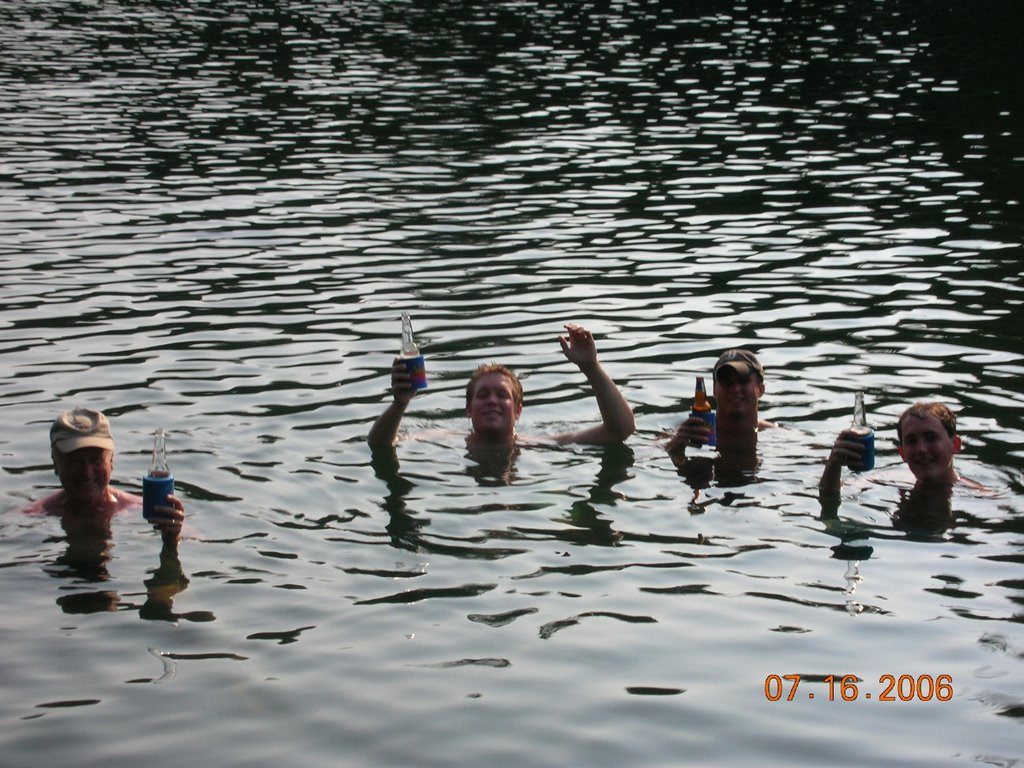
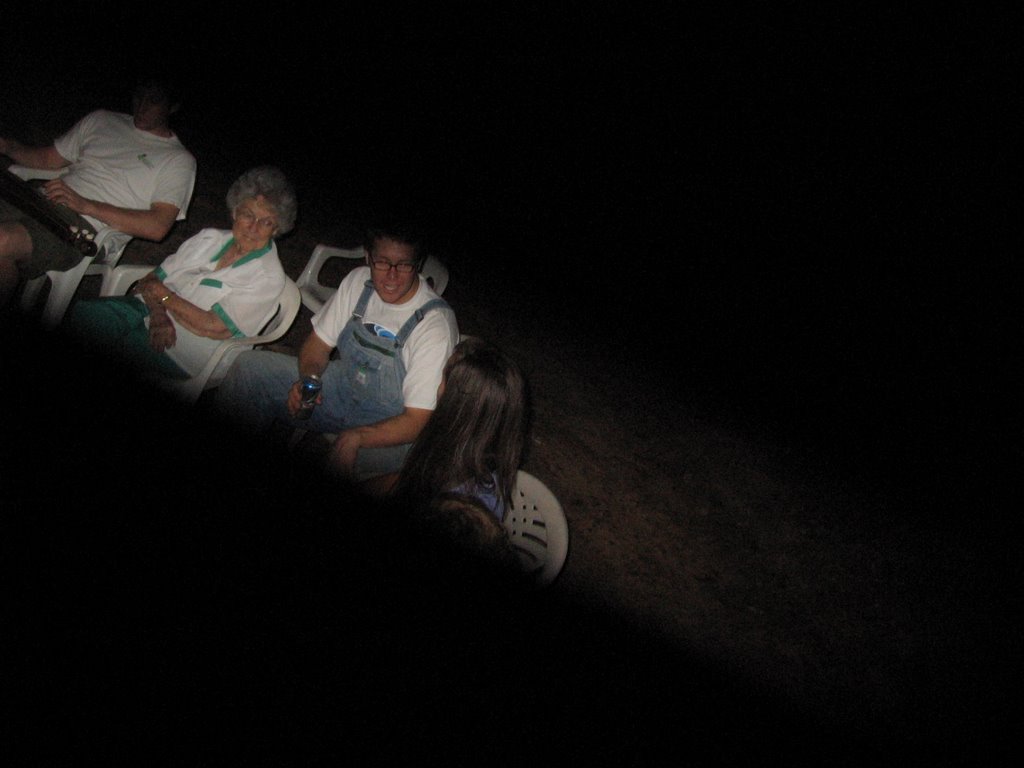
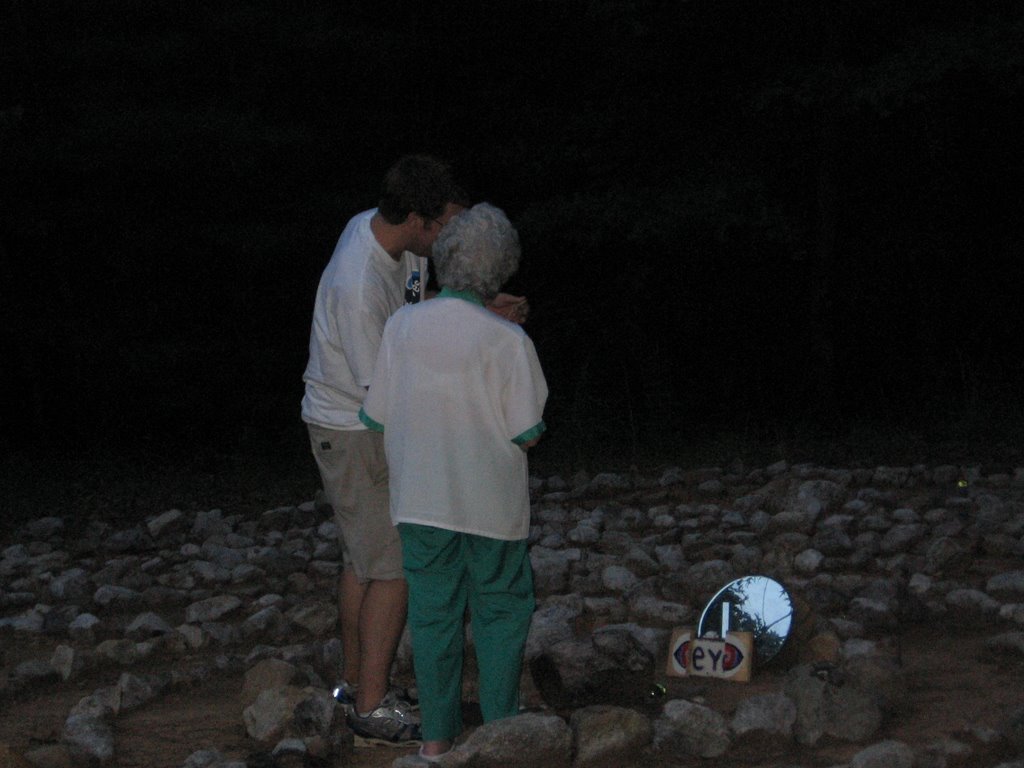
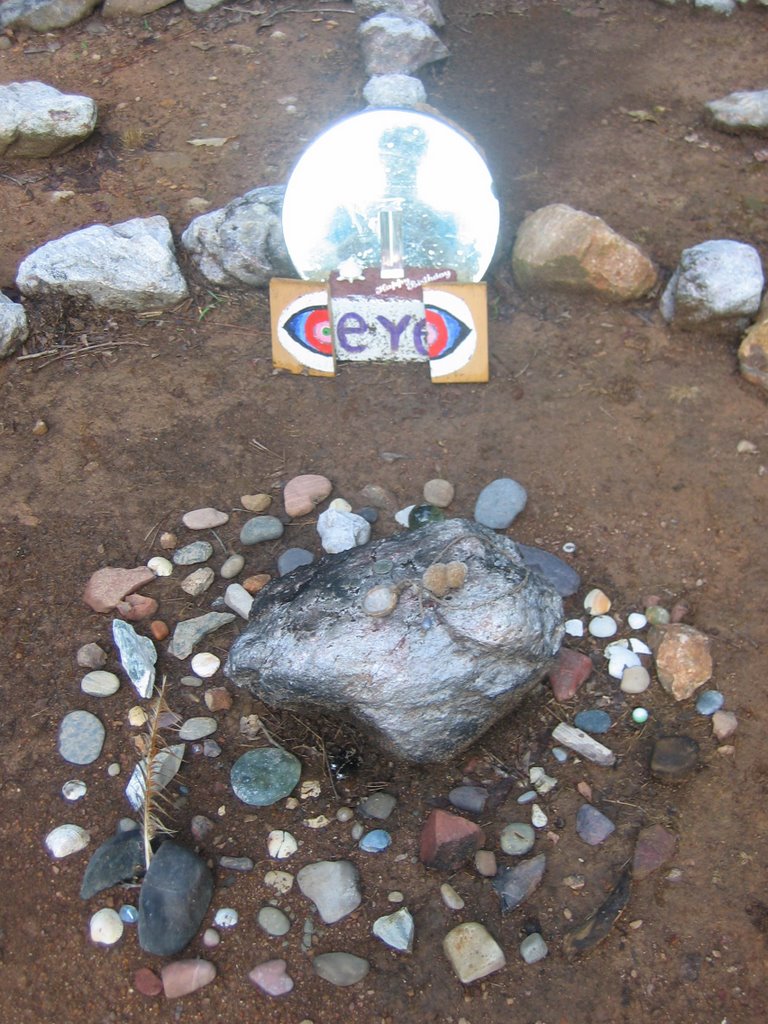
So it’s been a busy two weeks or so since the cousins got here. Lot’s of explosions, overalls, firewood, beer, Grandma, cooking feasts, storytelling, plan making, life strategizing, memory trading. Here’s what we’ve been doing, so two nights ago we had a few of the cousins’ local friends over and had a fire up at the Labyrinth and skewered hot dogs over the flames. We didn’t feel right leaving grandma in the house all by her lonesome while we went up to the spot so she decided she’d just come up with us.
“Hey Grandma why don’t you come up to the fire pit with us for a little bit?”
“Alright, I’d like to see that. You know what I’d really like to see sometime is the Labyrinth.”
“You’re in luck Grandma, that’s where we’re goin’, that’s where the fire pit is, right next to the Labyrinth.”
“Oh Boy!”
Having Grandma up by the Labyrinth really tied the whole scene together. Before Pop passed she wouldn’t leave the house because she wanted to always be there by his side, but now that she’s freed up a little bit her curiosity is getting the best of her. The other thing I noticed is the chair by the picture window, Pop’s chair, is now Grandma’s throne. She love’s that thing, sits there all the time now and looks out the window.
“So this is where you come every night, I seeee. Sure is a unique place to sit and rest your bones after bein’ in the sun all day. Yes yes, I see. This really is something special.”
Tyler dropped his hot dog in the ashes and we told him he just needed to give it a beer bath and it would be fine. We relayed this to Grandma to which she replied, “Shoooot yes, that’s a good idea!”
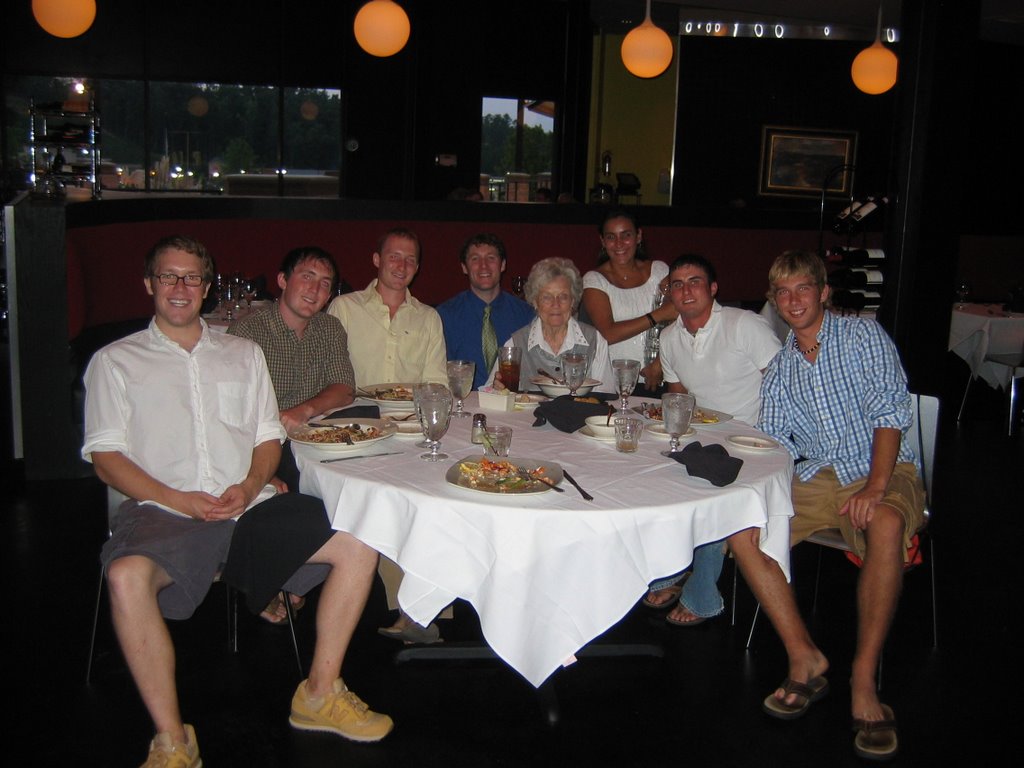
The next night we took her out to Brooks’ restaurant and showed her another great time. Five young men and Grandma have quite a presence in Classic Joe’s. There was even a band playing out on the patio under the oak tree so after we finished eating we all went and sat out under the tree and listened to music. Josh was after the hostess but the only contact he made seemed to be an exchange of smiles.
We also cleared out the patch of trees in the field straight in front of the house and collected some big rocks and made a new fire pit, which is actually six pits in one. We burnt off all the brush and grass we cleared out of the cove today, and I think we’re going to wait on havin’ a gathering there till it gets a little damper.
We also discovered that all the locals hang out in the parking lot of what was formerly known as the Winn Dixie. We also realized we don’t need to stress about meeting locals either, we might be cooler than the locals and that’s just fine. The Suttles never really did fit in just right in this valley, and we kind of like it that way. We made it our own.

It’s also been a month as of Wednesday.

Night before last we cooked ribs.

Trey and Mike and the Duo played in Atlanta n Saturday so I went over to see it with some friends and some old friends. The show was pretty good, the scene was bigger than I expected. Phish fans die hard it seems. They didn’t play any Phish songs except for an acoustic Mexican Cousin which was pretty sweet. Drifting, Sweet Dreams Melinda were favorites too. They covered the Who’s Who are you? Who Who Who Who? (oooh I really wanna know) and that song that goes “Get back, get back, get back to where you once belonged…” Song choice seemed fitting, it was a good time all in all, nothing the fanatics would go insane about, but I think that’s what they’re goin’ for these days. New fresh music, nothing insane, manageable good times, rock stars with families.
I went down Friday night and hung out with the Cook’s and got to met a few of their family friends with Bowen and James and then spent the night at the Wesley’s in Norcross. They’ve got a beautiful set up by the Chattahoochee river and all in all it was a great time. I seem to be drawing myself as close as possible back to the people my Dad knew and the Wesley’s were friends with my parents since before I was born. I think Tom and Dad kept each other in competition for an edge on the god life for a long while and it was god to see traces of my father there. Nothing too specific, nothing I could point to exactly, but the vibe was there. For example, their perfectly ordered and appropriately labeled garage reminded me of Dad a lot. It’s so nice to be around really good people. Good to the core.
I’m not going in order so back to when Sunday I drove up to the Wesley’s lake house on Lake Burton in northern Georgia and met up with Lance and Troy and Josh and Tyler and the rest of the Wesley clan, Emmie, Tom, and Kathy. They were fantastic hosts and we had a great time all around. Can’t thank them enough for that, they did everything they could to make sure we had a great time, and we did.
Coming back we stopped at a Georgia fruit stand and I picked up some Pear, Peach, and Black raspberry preserves for Grandma because I know she love’s them and then headed back to the farm where we proceeded to run on high octane and be wild Indians in the fields all night. Someone somewhere ordered a box of about 100 glow sticks and we all painted our face and opened our toy-testing clinic for the night. Last night was really special and the cousins all swapped stories about Pop and talked about how important the farm is and why it’s worth sacrificing for because it’s the realest thing in the world to us. We played with the acoustics in the valley, philosophized in the fields and thanked God for where we are.
Lance and Troy used to live on the farm when they were younger and so they had a bunch of Pop stories I hadn’t heard before. My favorite of the night had to be that they remembered when Pop would spend all day on the tractor out in the field in the fall, then he’d come in and build himself a fire in the fireplace and then lay down right next to it on the floor, warm himself and take a well deserved nap. Perhaps this explains my affection for warmness.
This is a pretty surface level rundown but it’s been a while since I updated so I figured I should start with the surface and work in the deeper revelations of the week in the days to come. The cousins leave tomorrow so we’re doing a final meal at the farm and then it’s back out into the real world for them, and back down into my soul for me. A lot has happened, we’ve had a few “day of days” and I’m deciding how much I should post and how much I should funnel to the publisher. You never know where it’s going to start or what’s going to start it. Seed crystals come in all shapes and sizes, in all sorts of moments, from behind all sorts of eyes. A smile from the girl you didn’t know you loved, a handshake from a stranger at the cafe, a punch across the face from the person who deserved it, you never know, it just happens and if you notice it's happening as it happens it sort of like, you know, spirals into an attitude boost and a self shaper latte.
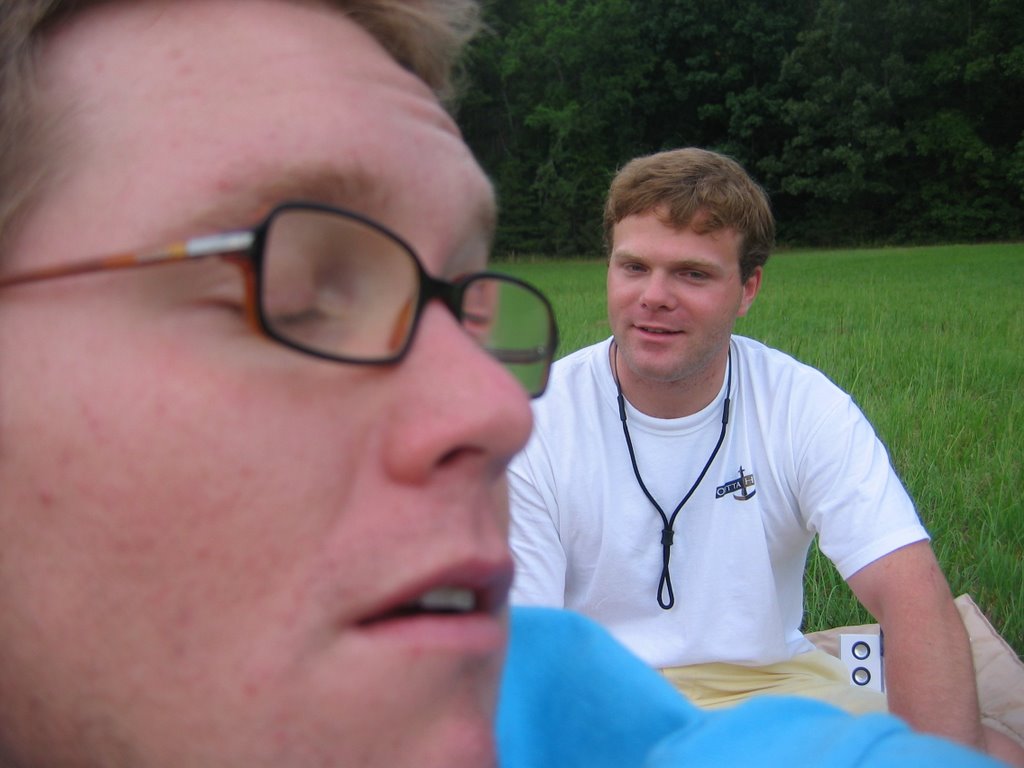
For example on the way home from Atlanta I stopped at a Waffle House surprise surprise and had the most memorable Waffle House experience of my life to date actually, which included an hour long conversation with a late sixties year old stranger named Francis Beedle who told me to really see, to really understand what’s going on in the world, you have to detach yourself, and I mean really detach yourself. “You gotta go sit on the moon and look back and then and only then can you really see what’s happening.” Like I said, there’s a lot more to that story but it’s dinner time and I’ve got to run…

Wednesday, July 12, 2006


there's lot's going on, too much to have time to update, but it's on the way...

Monday, July 10, 2006

headache free


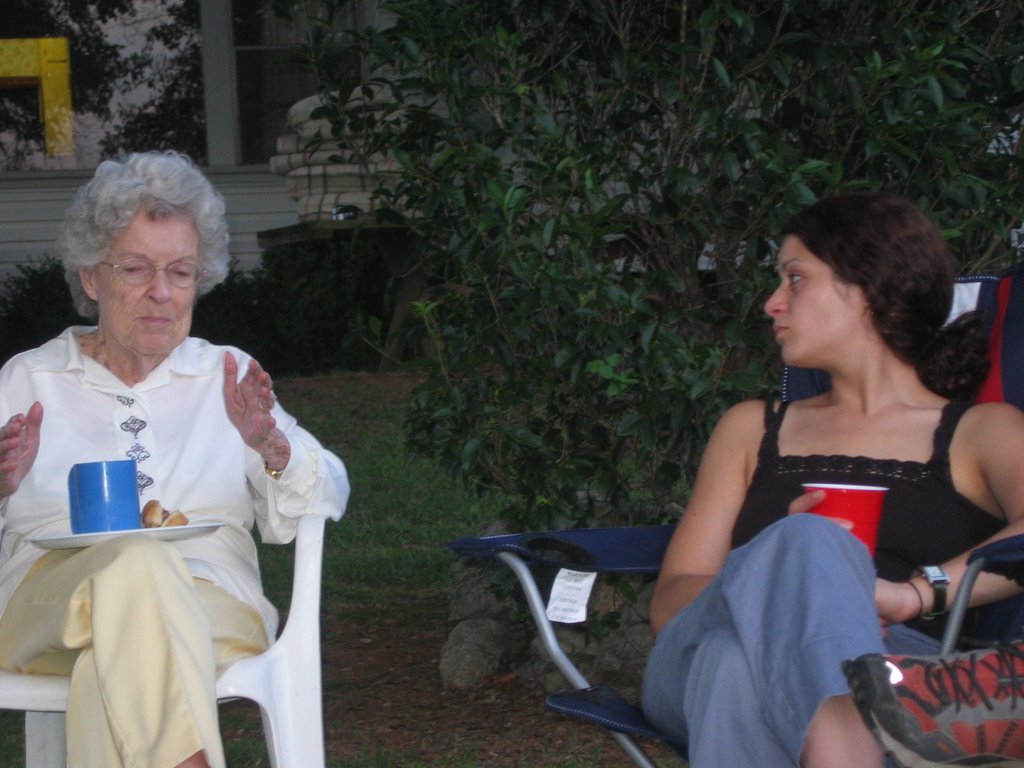
In grandma talk for the day Mollie asked her if she had any Tylenol because she had a headache (look at the expression on her face when she’s talking to Grandma) and grandma said she may have some but she wasn’t sure. Mollie went off to look and while she was gone grandma told me, “ You know, I’ve never taken a Tylenol because I just don’t get headaches, but I guess there’s some around.”
“Wait, Grandma, you’ve never in your whole life taken a Tylenol?”
“Tylenol? You know I really haven’t. My whole life I never remember getting a headache except for those three days before my heart attack. I remember telling Pop, ‘now I don’t want you to cry over me but my head hurts like the dickens!’”
The story behind this is that one time in 1984 I believe Grandma was in the car next to Pop when her heart stopped, “right about where the fruit stand on Hwy 26 is.” Pop was screaming at her to wake up is how I’ve heard the story and he redlined it till he got to the closest house with a phone to call 911. But what’s incredible, and I mean this is amazing on all sorts of levels but Grandma probably never thought twice about because that’s how humble she is, is that her heart restart itself. That’s right, it stopped for about 3 minutes they guess and then it restarted itself. What is the symbol of a heart that restarts itself? If you know Grandma, it kind of makes sense. It’s weird and it’s not a rational understanding, but you understand. The woman never in here life remembers having a headache except the few days before he heart stopped. The level of purity her is amazing, and Pop wasn’t allergic to anything, and I thank God for the stock I came from and feel like such a wuss for ever having taken a Tylenol.

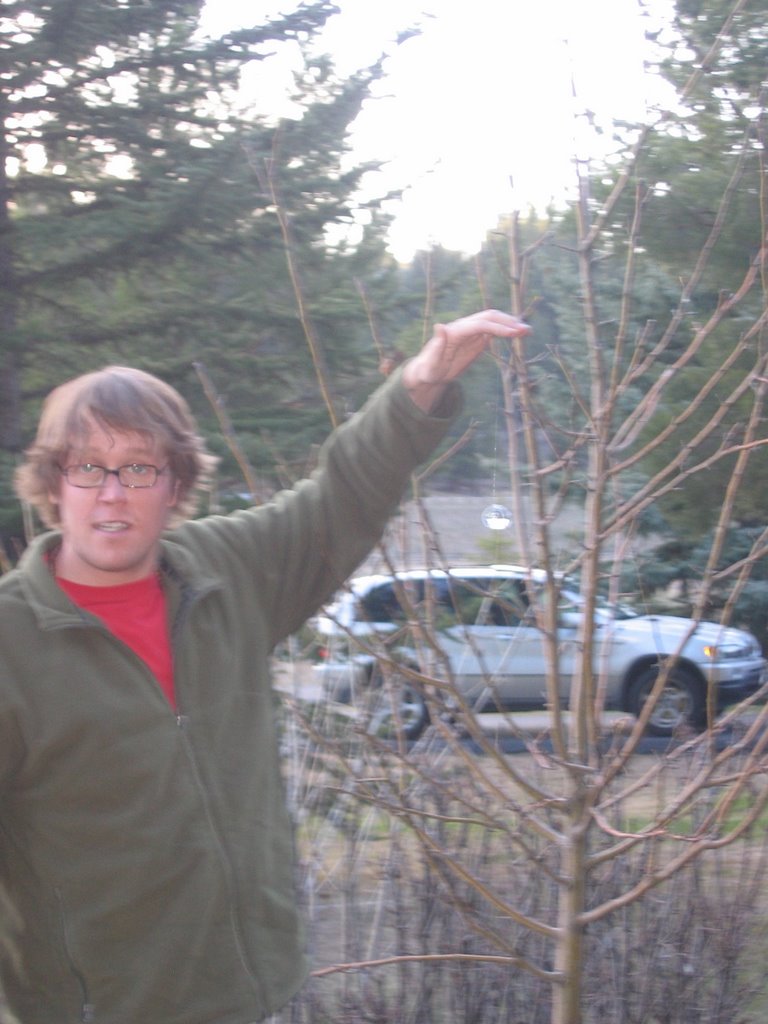
full moon in the background


The cousins got in town at about 4:30 am Sunday morning so when I came over to pick up grandma for Sunday School they were already here. Sunday school was great but it’s strange to study the Bible from a faith based perspective after I’ve been crunching it academically looking for underlying patterns and hidden deceptions and double meanings for so long. You know, you can get a lot more practical advice from the book if you just take it for what it’s worth, so I tried that this week and it really worked. I choose to be joyous, as do you, so don’t forget and get down.
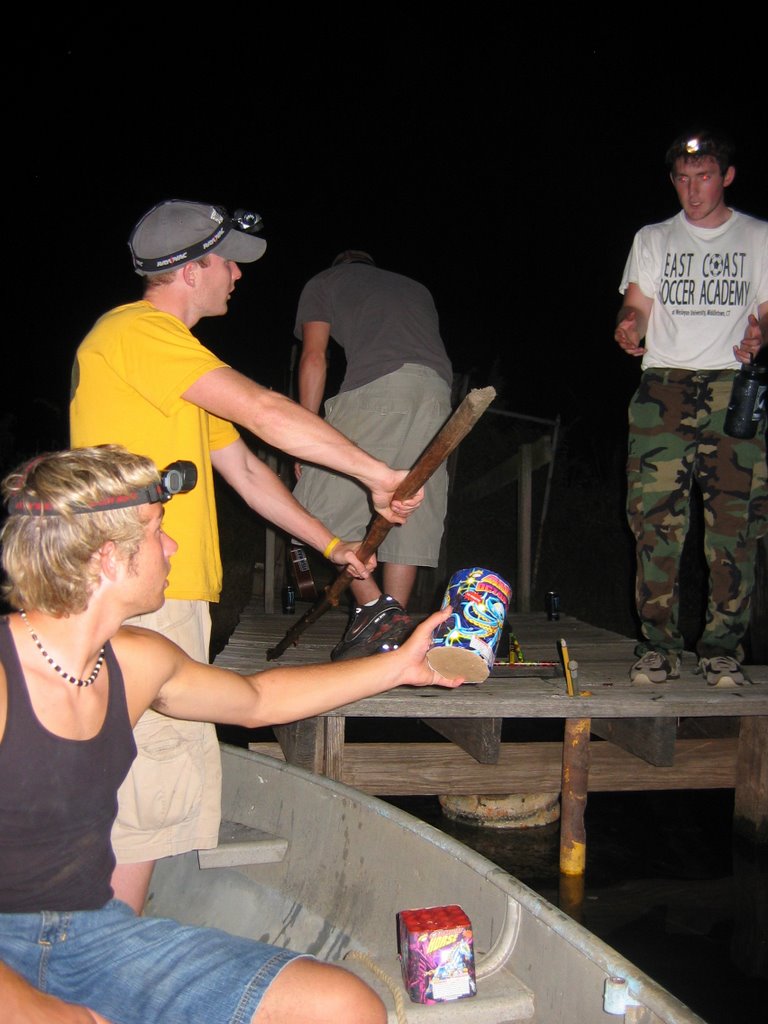
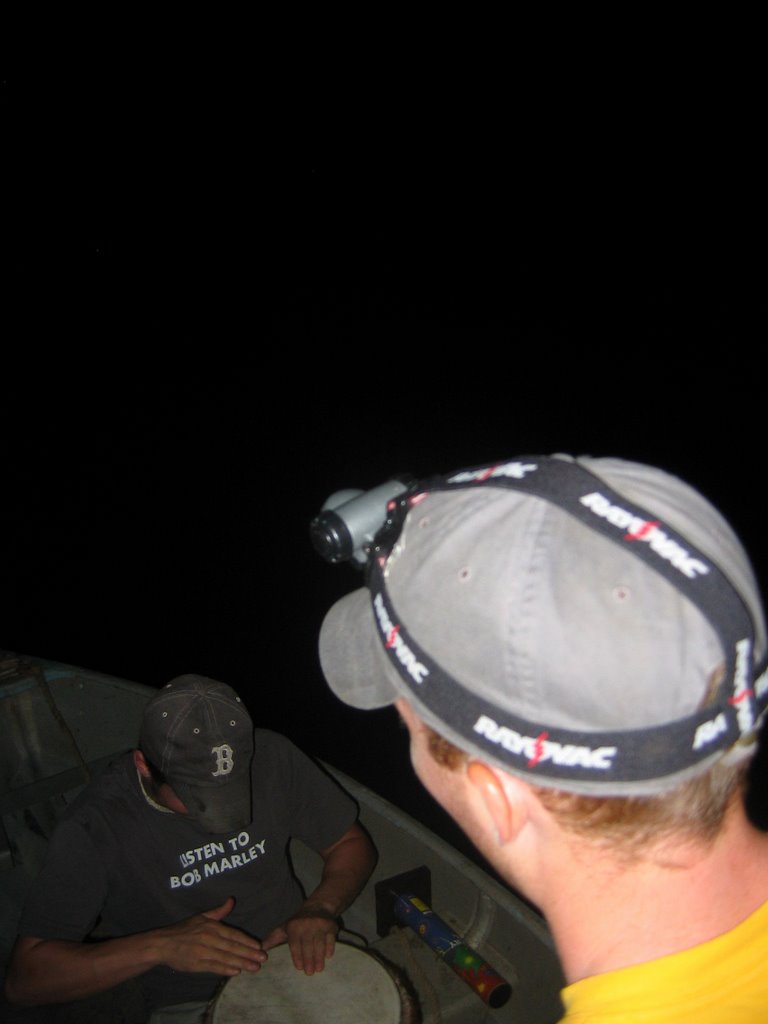
We came back, I cooked the boys a hearty breakfast of sweet corn and eggs, hash browns and bacon, and then we got to it farm style. Tyler brought an unbelievable number of fireworks. I am not at all exaggerating when I say three large trash bags full. Those started to get lit off nonstop for the next 10 hours I would say. We hit up Piggly Wiggly for Bar-B-Q fixin’s, had a monster roast, and then we went down to the dock and some of us got on the boat. Lance, Tyler and me went out on the boat and started lighting off fireworks from there, which wasn’t the safest and brightest idea, but it was quite a rush nonetheless. I had the djembe and beat along with the explosions, a firework soundtrack if you will, and we all had a great time.
Brooks and Mollie were on the dock when they looked down into the drain and noticed a turtle was stuck at the bottom of it about 15 feet down. At that point, given their affection for aqua-terrapins and the mystical fog they’ve been bringing with them lately, the mission became rescue 911 meets arts and crafts as we had to devise a way to get the turtle up and out.
Brooks went up to the garage and rigged up a sort of grill-scoop on the end of a long pole and they tried with that for a long time but there was this blasted root/branch that kept getting in the way and we couldn’t get to the turtle. I suggested we just get a bucket and fill up the drain with aqua and float him to the top, but that didn’t work because, well, it’s a drain. The water drained. Then brooks decided the angle of the scoop is off so he went back up to jerry-rig a new pole contraption, but the darn branch was still there. Brooks was 100% committed to rescuing that turtle at that point, and he new he had the perfect tool to cut the branch at Nell’s house, so he got in the car and drove over there to get it. While he was gone though, Josh used his scoop and told the turtle to climb in the basket, which it did, and was able to successful extract the patient from the drain. Molly cheered up, we put him in the bucket, and now he’s in the fountain up by the house that Pop made.
We were worried he wouldn’t have anything to eat, but incredibly it seems the two frogs that had moved into the pond while Pop was laying by the picture window must have spawned because there are a bunch of tadpoles in there now. Wow! Life!
So then Brooks suggested we get a few tadpoles and put them in the old red-eared slider turtles cases that we weren’t using anymore since brooks got the 55-gallon tank- and hatch a few more frogs while we’re at it, yeah? And so now it’s today and I suppose it’s just a matter of time before it happens.

sunflowers from seeds


so these are the sunflowers Lauren planted from seeds sometime back in May, and look how tall they are! Wow is right! They haven’t even started to shine yet, how exciting…

the bubble solution


Time works a lot like bubble solution/bubbles. (What is the relationship between bubble solution and bubbles I might ask?) It’s all coming from the same stuff, the solution, but no two bubbles are a like, like snowflakes, and people. For a myriad of reasons and factors one large breath may blow 100 different bubbles of different shapes and sizes and locations. The location plays a big role in the life of the bubble after all since you can see right through them. Where they are has a lot to do with what you see when you see right through them.
Moments too are kind of like bubbles, and when you have great “aha!” moments they are like great big bubbles. Big bubbles are like great moments. Moments where all the different angles and jigsaw pieces of your life come together for a moment and you see the bigger picture, you relate to your environment, you feel expanded, you get it, but just for the length of the bubble. Then like all moments all bubbles burst and your back to swimming in the puddle of time continuum solution before the moment comes along and you blow your next big bubble.

Saturday, July 08, 2006


lauren's art show at the farm opened today

attic gold


Friday, July 07, 2006

morphic units, the head of a paradigm


Grandma talk today:
Grandma remembered how she used to get the boys matching outfits to wear to school and did the whole twin gig until they came home and said, “Mama, people down here don’t dress like this,” and that was that, she said. “Shooooot yes, we took care of that.” They got themselves some blue jeans and whatever everyone else was wearing. They didn’t want to stand out anymore than they already did. She remembered them saying how they would have trouble with the other kids standing in the lunch line because people would, “Bless them out,” thinking they cut in line or went through twice. People didn’t know there were two of ‘em. Not to mention that they lived outside of town on a bus next to their house.
Grandma told me they split the boys up to take a test one time, each in a separate room, and both of them only missed one single word on the whole exam and it was the SAME WORD! I’ve been reading about morphic fields and morphic resonance and hearing this story I am reading about formative causation in a whole new light. Do twins pull from a collective memory? Do species pull from invisible but collective banks of habits?

Morphic field: a field within and around a morphic unit which organizes its characteristic structure and pattern of activity. Morphic fields underlie the form and behavior of holons or morphic units at all levels of complexity. The term morphic field includes morphogenetic, behavioral, social, cultural, and mental fields. Morphic fields are shaped and stabilized by morphic resonance from previous similar morphic units, which were under the influence of fields of the same kind. They consequently contain a kind of cumulative memory and tend to become increasingly habitual.

I tried okra in my eggs this morning. Pretty good but you gotta simmer them with the sweet corn and the onions in the skillet before you put the eggs in. Flavor it up with a little bit of basil or Butt Rub too, slow cook some bacon in the skillet next to it and you’ve got yourself a wonderful start to the day.
Have you ever noticed the flight pattern of a mosquito that’s buzzin’ in your ear and around your head and never seems to stop or stay still or repeat itself? I find that my point of awareness, that dot of focus that is the 7% of my brain I use at any given moment seems to bounce and dart around much the way that stupid mosquito does. BZzzzzZZzzzzzZZZzzz. From thought to thought to feeling to observation to hunger pang to thought to revelation to guilt trip to thirst and back to the bathroom and the thoughts in there. Always back to the bathroom, and sometimes in the shower. Now the shower I like because I can keep myself paying attention to the water, and even though that’s not one thing it’s still all over and enough to keep my mind on point, Aquapoint.

------------

Gone
Joack Johnson

Well look at all those fancy clothes
But these could keep us warm
Just like those.
And what about your soul
Is it cold
Is it straight from the mold
And ready to be sold.

And cars and phones and diamond rings
Bling, bling
Those are only the movable things
And what about your mind
Does it shine or
Are there things that concern you more
Than your time

Gone going
Gone everything
Gone give a damn
Gone be the birds when they don’t want to sing
Gone people
All awkward with their things
Gone

Look at you out to make a deal
You try to be appealing but you lose your appeal
And what about those shoes you’re in today
They’ll do no good
On the bridges you burnt along the way

You’re willing to sell anything
Gone with your herd
Leave your footprints
And we’ll shame them with our words

Gone people
All careless and consumed
Gone
Gone going
Gone everything
Gone give a damn
Gone be the birds if they don’t want to sing
Gone people
All awkward with their things
Gone

Thursday, July 06, 2006

just because wild cat's don't have litter boxes...


July 6th

Porch Talk:
Grandma told me this evening about how she was sitting on the porch watching the stray cat that seems to have adopted itself here for a long time this morning. She said she watched him dig in the ground for a good long while and she couldn’t figure out what he was diggin’ for. Then she realized what it was cause he went and sat right on top of it and (see Grandma doing a visual in your mind’s eye right here of the cat going from digging to sitting on top of the hole it dug for itself) “And it did a job!” she says. “Funniest thing about it was the way it sat up on its hole like it did (she does the cat-pooping-in-hole imitation again).”
Now that’s funny. Funniest Grandma moment I’ve had this week for sure. The look on her face as we were laughing, priceless. Then she goes on and says, “Yeah! Then he covered it right back up and I thought, ‘Golly I could step in that!’”
The cat seems to have been getting some loving from somewhere because he gets more and more brazen about coming up to you for a rub or a pet every time. He started rubbing on grandma’s leg and she was so funny talking about how she didn’t want to be mean hearted towards you cat, “but I don’t want to pet you cause I don’t want you to stay. I wish I could just give you some food and have ya be on your way!” Rolling laughter, my gosh if you know Grandma you know what a delivery that story had when she told me. Gosh, so good.
Oh yeah this is the other great grandma comment of the day!
The turkey’s, come to think of it, have been missing from the fields for a few weeks. I hadn’t really thought about it until Grandma said something though. We used to see them everyday and then they’ve been gone for a bit, but today I saw them out in the field again, but this time there were two big turkey’s and four little ones. I told Grandma that I’d seen the turkey’s today but there were two big one’s and four little one’s and she said, “Ooooooooh, so that’s where they been, makin’ babies! I been wonderin’ bout them. They must have a nice home back over there in the woods, that’s where I always see ‘em.”
She was so delighted. Life on the farm, you just can’t stop it.

There was a really big storm today, finally really let out some hard rain for a while, but afterwards it cleared up and the sun came out just in time for a bright exit into sunset and life was especially pretty we commented. The fields seemed to glisten in the rain and the bright sun and all the birds and bugs were singing after the rain too. The hummingbird is hanging around the porch again too. Hummmm, I wonder…

the more you know


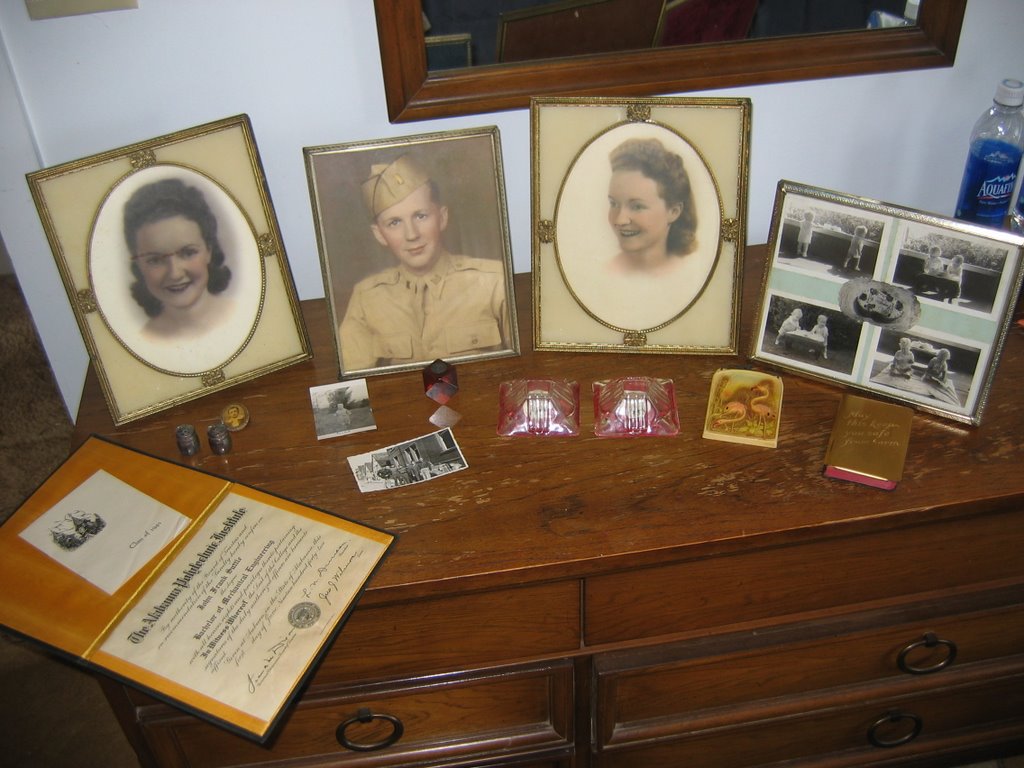
More gold from Grandma’s digging. Somewhere in one of Pop’s files she found out where he or someone else had typed out a short little two page history of Columbiana. It’s a small little place but it’s a good one, so if you know it, now you know…


The History of Columbiana

The City of Columbiana is in Shelby County, Alabama. It is the county seat of Shelby County. Shelby County was named after Isaac Shelby, Kentucky’s solider-governor who had been a Revolutionary War hero. He refused election to a second term as governor in order to fight in the Indian Wars. Although Shelby County has not had a very exciting past, there are a few incidents and people that are outstanding.
Most of the early people of Shelby County first lived in Montevallo, Wilsonville, and Harpersville. They originally came from Tennessee and Kentucky. The people who first lived in Columbiana moved in from Wilsonville and Harpersville.
In 1826 a county-wide vote was taken to decide whether the court would be moved from a little log courthouse somewhere near Pelham to Columbiana or to Montevallo. Columbiana won the election and to celebrate, the people made use of a large pine tree, since they had no guns, bells, or whistles. The citizens bored holes in the tree and filled it with powder. When touched off, it made a report which was heard in a four mile radius.
There are no old houses or ancient landmarks in Columbiana that date back earlier than 1820 because titles were not granted by the government until after 1821. Early white settlers held their land by virtue of what is known as Squatter Sovereignty. Also, there was the fear of attack by marauding bands of Indians who occasionally made destructive forays into the county. The settlers dreaded constantly having their possessions burned or stolen.
When government land offices were opened, farmers and others rushed in to supply for receive title of the choice lands. They then began improving their lands and by the 1850’s there were many fine houses around Shelby County and Columbiana. One is the home of Mrs. W.W. Wallace; one is the old Leeper place built in the 1830’s by judge J.T. Leeper and now owned by Harris M. Gordon, and the third is the original home of Jefferson B. Elliot and now known as the Bolton-Walton Funeral Home. William Atkin and Joseph Howard were the first comers to Columbiana. They cleared the land on which it now stands. When Columbiana became county seat in 1826 the Court House was established in a framed school building and remained there for 28 years. In 1854 a red brick building of more permanent nature was built on the same site of the school building. This building proved inadequate from the start. The building originally cost $2, 500. It included two large rooms, two smaller rooms in front of these, and one large room on the second floor to be used as a court room. The two larger rooms were used as offices for the Judge of Probate and the Registrar of Chancery. The two smaller rooms were for offices of the Sheriff and the Circuit Clerk. In 1881 alterations were added to complete the building. Added was a grand jury room in the back of the building and a vestibule in front. Several years later two small vaults were added in some of the offices.
Judge James T. Leeper was Judge at the time of completion.
This building remained as the court house until 1905 when the Court House was moved to its present site on Main Street. This new structure cost $300,000. It was built of Georgia marble. When the county outgrew this, a brick annex was added to the rear of the Court House. It contained offices and a jail on the third floor.
The first jail was on land located near the present L $ N railroad station, This gave place to the red brick jail on White Street. It was vacated in 1955 when the prisoners were moved to the new jail above the Court House.
The Town of Columbiana bought the old brick court house for $5000 and converted it into a City hall. Before the new City hall was bought, the offices were in a small structure on White Street that was built during World War II. Later it was enlarged to house the fire department and wil continue as the Fire House.
Among the men of affairs who were large land holders and had a prominent part in the development of this part of Alabama were: George Phillips, chief justice at the fist court held in Shelby County; Bennet Ware and Patrick Hayes, other justices at this court; Jacob Lawler, the presiding judge when the court was moved to Columbiana in 1826; Wiley H. Pope, Robert Bowden, Rubin Mardis and his two sons, N.B. and Samuel; Joseph Roper, Alphonso a Sterrett, Benjamin Wilson, David and George M. Mason, the Nelson family, and others. Many of the earlier settlers left the area before and after the War between the States. Some had been leaders in its early development but decided to try their fortune in Texas or farther west. Others went to Birmingham to acquire wealth and distinction.

Wednesday, July 05, 2006

the duo


"hey, what's that on my shoulder?"

Tuesday, July 04, 2006

The Clipboard


Glowsticks, roman candles, artillery shells, 15 foot fire pit, labyrinth, sweet tea, scrambled eggs, scrambled eggs with sweet corn and onions, waffle house, crickets, fire ants, bluebird houses, the bridge, hay bales, boxes of photos, the picture glass window, the porch, the fields, the E-Z-Go, the trees, the hills, tiki torches, green glass marbles, guns, sawhorse, watermelon, waterproof wicks, grandma, icee pops, neighbors, pink flamingos, tin roofed barns, hot rain, bow and arrow, majitos, soundbites, fear, truth, functionality, memory loss, stupid people who love being politically correct, subconscious, uberconscious, unknown factors, white coats, lies, time, space creators, money, greed, flashlight, gong, fire, ripple, lake, creek, drum, orbs, family, patterns, deeper patters, life cycles of bugs.

Is/was Self I am/will be


How many July fourths can you remember? I remember the one I went to see Phish in Philly that year, that one in Germany, the Cheese show in Steamboat, a few at the farm, one at camp… these are all out of order but I’m free to remember them any way I want aren’t I? Aren’t you?

So I’ve been invited to attend Sunday school with grandma on Sunday and being the religious studies expert that I am (ha ha ha) I’m so – excited? Is that the word? Grandma hasn’t been to church in a good long while since Pop had his stroke and couldn’t attend himself, so it’s a really good thing I think for her to start back, the community missed her. She went this past Sunday for the first time in a while and seemed to really enjoy it from what she said. What she really enjoyed was when she talked to Pastor Miller and told him that I was going to come next Sunday and he took a personal interest in it. As she was leaving he told her he was looking forward to seeing me next week and that he’d like to show me around personally. Oh boy, what did I get myself in to? I hope it’s something deep, I think it is, in a not too deep way. Chuckle. I want to be careful not to sound aggressive when I ask the questions I’ve been asking about the Bible and Christianity for some time now, the fine and subtle points I learned to pick on when I studied religion as an academic. I want to be careful because I’ve been doing that sort of questioning for a long time now and it gets to a point where you start to wonder if my exposure to so many different sets of truth has turned somewhere along the way to have a type of gridlock, paralyzing effect on me. In a way I worry I sort of flooded the system and lost touch with my original motivating force which was to dive into the deepest hardest brightest truths about life and perhaps religion was just another deep pool of water search through to find who else knew to love God, to feel God, to be in touch with God in all aspects of nature, without, of course, being naÔve about the hokey pokey sheepherder stuff. I know that I am in touch with God, it is the underlying principle that allows the proposition of the question to even be possible in the first place, which it is since we are asking it. Get it? It’s more than a principal really, because it’s a known. That I know God exists is my bedrock, but now what exactly God is or looks like or where the boundaries between me and God or God and me are, those sorts of things are still out on the table. Every year it seems I need a bigger table to lay out all the new things pointing towards the character of God and me I come across, and at some point I want to simplify. Clutter is for confusion, is for the search and the collecting of data, for opening up space or Providence to hook together the non-linear self-evident realities of it, but how long is that going to go on? You can’t think your way to happiness, God is not an intellectual lesson to be learned, it is, it is, well what is it? He? This? Us? You? I? The? Am? Really, what is the arrival of an understanding of God like? This is not a rhetorical question people, I’m really asking you, what’s it like? Tell me about it, please. I need something smart to say on Sunday…

It feels like I’m getting defensive about something. An output of some sort? Input? A clog? A clot? A kink? An opportunity to have a better flow? How do I look at it with most Quality? Most truth mixed with most uncertainty? How does one live on the cusp of the wave? When you get away from it you just think you’re getting away from it. It’s just for a moment you think it’s vaporized itself for something and you manage to fall back asleep and then it’s a week later when your baby gets stuck in traffic and you turn irrational again and fail to make the rational connection to the illusion you had of getting away from it. It can get bad.

Pierre


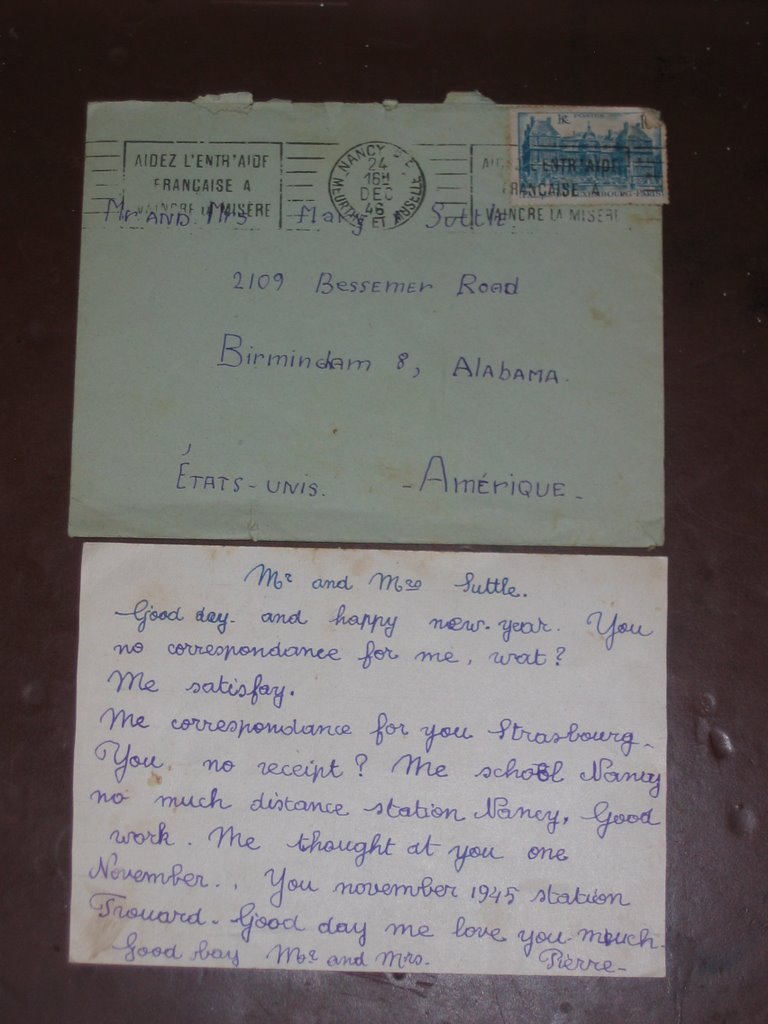
Grandma has been spending a lot her time going through old letter's from pop during the war and such and today she found a letter from Pierre, the french boy Pop kept in touch with. The pic is above and i translate below as best i can. Language is so funny...

Mr. and Mrs. Suttle.
Good day. And happy new.year. You no correspondance for me, wat?
Me satisfory.
Me correspondance for you Strasbourg. You no receipt? Me school Naney no much distance station Naney. Good work. Me thought at you one November 1945 station Trouard. Good day me love you much.
Good day mr. and mrs. -Pierre

The Miracle Bubble Metaphor


follow me now...

Every bubble has a direction set, a floating point of center, a subjective equilibrium.

One set from one center and these are: North south east west up down in outside inside before during after, don’t you agree? Did I miss any? Sketch it out and see, I may have. Draw a quick bubble and label all the directions it could go if you were a point of awareness in the center of that balloon. Did I miss any?

Could you say everybody’s head is a bubble and that same set applies directly?

Is that set a whole set? A universal set of characteristics that every human being has? No matter if you’re black, white, brown, red, yellow, smart, stupid, pretty, ugly, funny, obnoxious, preacher, sinner, saint, toad? Seriously, isn’t this a universal set of characteristics every human has, to varying degrees probably but still, it’s a universal set, am I wrong? Tell me if I’m wrong, please, I need to know.

Dare I say
In any moment of time
Every subjective awareness
Has these possible directions to go:
North South East West Up Down In Outside Inside Before During After.
Period?

Can you image what I’m saying here?
Do you get it?
Does it make sense?
What keeps you balanced and centered?
What holds you together?
What does the earth’s gravitational field look like?
How many miracles can you fit in a bubble?
How many miracles can you fit in your head?
How many bubbles does God blow?

Blow a billion bubbles
Blow just the perfect one
One is for the town you know
One is for your son
One is for your sweetie too
One is just for you
But Blow the biggest bubble for God
It’ll give you more of a view.

What links us all?
The Universal Direction Set…
…call it a Super Bubble Miracle Set why don’t ya?

Monday, July 03, 2006

Mind the Gap


Cole Suttle
December 3, 2003

The largest hurdle for the philosopher is to find a way to explain the existence of both Objectivism and Relativism in a single theory. To somehow link the paradox of separateness and the apparent inability of the subjective experience to be compared objectively. The unification of the part and the whole is the task of the modern philosopher because it is the apparent separateness of individuals that is restricting the coalescing and harmony of the whole. This attempt to search for the meaning of life will be based on the premise that whatever the meaning is it must account for both the Subjective and Objective side of Truth and not exclude either/or on account of trying to keep it clean cut. By focusing on the relationship of the individual to the community I will try to find common ground between the eastern and western ideas of self realization and see if the problem is more one of semantics than ideologies.
The question what makes life worth living? is a fundamental jumping off point for the sincere adventurer looking to find some sense of value or worth in their awareness of their own existence. I use the word awareness because what is value or lack there of but an awareness of something? Going even further, what is it that shapes, creates, unfolds that awareness? Owen Flanagen begins with the question what makes life worth living and examines its assumptions and the problems it brings rise to when accounting for the meaning of life. Though I’m content with the mentality of Flanagen’s conclusions, his choice to attempt a theory that includes everyone restricts him from being very detailed. The way to the meaningful life in one cultural context, China for example, might not sound the same as in another, America for example. Where he lacks practical advice leaves room to look elsewhere, even inside for specific guidance. With that in mind the practical advice cannot be introduced into this paper until after Flanagen’s argument has been laid out.
Beginning from a very base, literal view Flanagen takes living to mean, “time spent not-dead.” (pg. 198) Aware of how reductive this definition is, Flanagen follows the discomforting implications of such a view to hunt down what makes a life lived, lived well even, different from a life spent not dead. What gives life value? What brings about a subjective awareness of truth, be it an objectively reliant awareness or ultimately entirely personal?
Using the example of money, something which has no value until it is assigned by us (the individual and the social setting) to have worth, Flanagen claims that material value comes short of explaining where the meaning of a life well lived comes from. The wealthy Sultan cannot be said to be living a meaningful life strictly on account of his possessions. Happiness, something more personable and closer to the heart of things, does not justify the origin of worth in a life either. Even a life chock full of happy moments doesn’t necessarily validate a life well lived. “Properties of parts do not confer the property of the whole. My parts are small, I am large. Happy times, even many of them, might not constitute a life well lived.” (pg. 199) Though Flanagen does not say the meaning of life is absent of happiness, he is cautious to point out the danger of relying too heavily on the subjective standard of happiness as a measure of the meaningful life. This is the Hitler question and the crux of the Objectivism/Relativism struggle, could Hitler have lived a good life if he was happy and thought he was doing something of personal value? There is something that grossly violates typical human intuitions about resolving to admit Hitler lived a good life because people simply aren’t willing to trust their guts.
What then, if material measures have value only to the extent it is assigned to them, and strictly subjective scales of happiness appear too vague and dangerous to be the end all aim, gives life meaning? Where is the middle ground? Flanagen argues that though Happiness is commonly thought of as a crucial component to the good life, there must be something else that validates living a life of worth. In an effort to link the western idea of individualism with the eastern philosophy of transcendence, Flanagen claims it’s the finding and creating of an identity and the expression of that identity that is the aim of the life lived opposed to the life merely existed. It’s one thing to claim life has meaning in the discovery or invention of an identity, followed by the expression of that identity, but how does one go about doing so? Flanagen chooses to speak in broader terms so as not to alienate the capacity for only certain types of self’s to fulfill this action, but falls short of providing the practical advice people need. Though this is intentional on Flanagan’s part, what good is a theory about the meaning of life if it’s not applicable to everyday people here and now? I’ll leave that until later.
Flanagan argues that though self and self-expression are not all that is needed for the meaningful life, they are indeed necessary. “If something-if anything, that is-is necessary for a life worth living, it is this: that I develop an identity and that I express it.” (pg. 200) But how does one go about developing an identity? Flanagen argues that it is as much the community as it is the individual that allows for both the creation and the expression of the self. To find an identity and express it requires a social canvas, even for the aesthetic monk who decides to leave the social structure for their identity, because there must be socially established expectations in order to transcend them.
After establishing that it is the creation and expression of an individual self within the context of a communal group of selves that gives meaning to life, Flanagen goes on to defend the reality of individual selves, or subjects as he refers to them, at all. This is where he bucks up against the Buddhist philosophy of no self. The eastern idea being that suffering exists only because we falsely identify with our self, and thus believe that when Cole Suttle is hurt I am hurting too. But why think there are no subjects? Flanagen asks, then breaks the arguments into three: the metaphysical, the sociological and the developmental understandings of what the self, the individual subject really is or isn’t. (pg. 201)
The metaphysical claim is that I am merely a set of eyes, but the vision and the ability to see is not my own. I am merely a “location” through which the infinite complexities of the universe collide for a moment’s awareness over and over again. The sociological argument claims that “I” am merely a schizophrenic actor living out a script society wrote for me. “I” exist only as the meeting or falling short of the expectations my community provides for me. There are only parts, but no legitimate middle sphere of unity that ties my “I” to anything separate, stable and distinct. The developmental perception of “I” is the old clichÈ that nothing is real but change itself. Any perception of myself as an individual, separate from the whole whose boundaries I cannot see, is merely an illusion. I am constantly changing, mind body and soul, and so to claim there is a representative center somewhere is false. Who I am now is not who I will be in five years, or whom I was five years ago, therefore I as an individual must not exist.
After laying out these arguments against the “Death of the Subject” as Flanagen calls them, he proceeds to slyly portray the assumptions each argument makes but ultimately don’t prove much of anything. (pg. 201) His personal strategy (because all we have in the end are personal strategies), is to accept that yes, subjects and individuals do change. They are always changing, on levels and planes beyond the everyday dimension of existence people are commonly aware of, but that hardly proves the false existence of individual subjects. As for the social role he admits this is true to an extent because before the individual gains control of their self-expression they have limited powers of free will. Growing up for instance, people merely fulfill roles society has for them without being aware of what they are really doing. But “being constructed hardly makes something into nothing.” (pg. 201) This argument merely shows that some are sheep and others are herders, and that there is a process of transition somewhere between those two that gives life meaning. As for the metaphysical argument, Flanagen draws on the assumption that to serve as a set of eyes, a point of awareness, is the effect of a cause, but every effect in turn sets off another cause, and thus another effect. So even if the subject is a constructed prism, it is fulfilling it’s instinctual desires actively, therefore setting off ripples that will in turn shape other “locations” etc. “Furthermore, the fact remains that evolution has resulted in the existence of organisms that have temporarily extended lives and are self-organized and self-moving in certain well understood ways.” (pg. 202) The direction of this movement is the concern, how do we know what’s moving in the best direction? Is it this movement that distinguishes the life lived from the life spent not dead?
Once Flanagan has safely secured the assertion that subjects and selves indeed exist on their own account, he has branched off from the Buddhist perspective that there are no selves, only constructed illusions of separate pieces of the whole. What Flanagen goes on to do is test the worth of a subjective value that exists as a result of an objective shaping, i.e. the village. He gives two scenarios, one of the belief in an omnipotent, perfect, all-loving, all-powerful Western sounding God vs. the almost Gnostic idea that the original force was an irrational one that wound the clock just before the big bang and then stepped aside afterwards, letting creation account for itself. Though these stories appeal differently to different groups, Flanagen is not content with their conclusions. They leave only an either/or option, not a theory that explains the existence of both an objective and relativistic perception side by side. To separate truth between individual and the whole is to miss the point.
The problem with the omnipotent God story is that it passes the buck by saying whatever happens is God’s decree and the individual has little say or value in the outcome or the shaping of the outcome of something so meager as I. This is why I find it strange when believers in this idea still claim free will. As if they are able to pick and choose what they are responsible for and not lay claim when bad things happens. As for the second, reductive scenario, Flanagan pulls in Nietzche and what sounds somewhat like Sartre in an attempt to take the responsibility away from projecting it onto an unexplainable omnipotent, all-loving, all-powerful God and onto the shoulders of the individual. As an individual, a real self capable of creating and expressing the best and worst of things, it is not the responsibility of some exterior God to make meaning of one’s life. It is the responsibility of the individual to create an identity with which to relate to the world and find value, which in turn is then expressed back into the world. A symbiotic, reciprocal system. This is a very important and self-empowering part of Flanagen’s theory. For the good life it matters very much that the individual apply themselves to their decisions.
Flanagen’s conclusions champion the meaning of life being in the relationship of the individual to the whole- other individuals or a more transcendent God. Ultimately value and worth come from the creative rendering of an identify using what the individual experiences internally as a result of the external world, but this is not to strip away the existence of the value of what the Self has to say. It matters very much what I say and do and want. (Flanagen pg. 204) Though rough an unrefined, Flanagen manages to fit the role of both the objective and the relative truths into a single idea for the meaning of life. He places, like Sartre’s existentialism, the responsibility for creating a life worth living on the individual, daring them to trust themselves and recognize their own identity, and then calling on them to express that identity creatively back into the big pot of existence. He paints the picture of an evolutionary community that feeds off each other, organizing and then reorganizing again and again as more material to be creatively painted with comes into awareness. Though he validates the worth of the community as w hole, he does not allow that to take away the value of the individual subject Science is an example of such unfolding truths that can be applied to the before to create an after, more aware perception. What is important is to remember science is only a tool that one day will need to be discarded for something that transcends it. Because there is a flow, a direction of movement in this evolutionary picture, it leaves open if not downright encourages the possibility of transcendence. “This is a kind of naturalistic transcendence, a way each of us, if we are lucky, can leave good-making traces beyond the time between our birth and death. To believe this sort of transcendence is possible is, I guess, to have a kind of religion.” (205) Is he saying humans are inescapably religious? What sort religion is he talking about that includes everyone? And luck, what sort of luck is he talking about?
One thing Flanagen seems to have constantly in the back of his mind is speaking in terms broad enough to account for everybody, everything; Nietzcheans, Libertarians, Buddhists, and Benedictines. (pg. 200) This choice, though productive in that it ascertains a.) the reality of individual subjects not dependent or shaved off some Higher, all inclusive single Soul, and b.) empowers the individual to trust all facets of themselves and the weight of responsibility to do so, ultimately lacks the practical advice many are looking for. How does one create an identity? How does one create the best identity? How does one express that identity? But before we delve into the practical advice of other philosophies, let us scrutinize Flanagen’s assumptions more closely.
The philosophy most closely related to a self-transcending meaning of life is the Buddhist philosophy which rears around simple statements such as, “so self, no problem.” (Kornfield pg. 12) Flanagen claims that his naturalistic transcendence theory incorporates the Buddhist ideals as well. Does it?
The Buddhist idea on how to live the meaningful life is to lose any identification with the individual self, Cole Suttle in my case, and fall into a connection with the larger nature of things, Buddha nature. Buddha Nature is the underlying fabric of all existence and as humans we become disconnected with this nature and suffer as a result. This philosophy is based around the almost Hedonistic idea that the best life is the life lived without suffering. That it is suffering which holds back the good life. Susan Wolf would disagree with this because she believes it is indeed the characteristics and variety of different selves that make life rich and worth living. This is why the Saint that gives up everything is only so appealing to normal, everyday people. To focus completely on becoming numb to the world, as it appears from some angles Buddhists do, is to miss the point of life she says. It would seem Flanagen might agree with Wolf as well in that he believes life is meant for expressing our selves as opposed to attaching to something established and hiding under it as giving your life meaning, when in fact its meaning is merely being fed to you. How then, can Flanagen claim to account for Buddhist philosophy in his theory and agree with Wolf at the same time?
There is a bit of word play when one reads Flanagen’s definition of the meaning of life to be for the self to identify with an identity, and the Buddhist idea that any identification with the self is the root of suffering, and thus the restriction of the best life. What are the ends of these two ideas? For Flanagen he is aiming at self-expression, a broad dynamic goal that does not end and is not achieved absolutely and finitely. For Flanagen it is a pure developing not a possessing that is important in the good life. It varies from identity to identity, but is no less more real or less real for those who do achieve such a state. For Buddhists the aim is enlightenment, which I dare say is synonymous with omnipotence, a transcendence of individual worries and restrictions and the dropping down into the void where all is said to begin and return to.
The reason Flanagen’s theory can coexist with Buddhist philosophy is because he doesn’t get explicit about what sort of identity need be created, only that creativity plays an important role. What would Wolf say about a person who does their best to emulate the saints in an attempt to create their identity and transcend their earlier limitations and doubts they have that the life of the saint is possible for them? Is Wolf a pessimist? It would seem the Buddhists too revolve their struggle for enlightenment around the problem of dualism as much as Flanagen does. To achieve that state they work towards tearing their awareness away from their individual characteristics and identifying with an omnipotent self, which they don’t call self at all. It is a stripping away of what they consider to be the illusion of our identity and reconnect with Nature and their place in it. Is the Omnipotent self an identity to be reached, and then expressed omnipotently? Can we, looking out from our uncarved, rough self centers of awareness pretend to know how an omnipotent self expresses itself?
This I feel is the link between Buddhism and Flanagen’s more cautious western self-realization philosophies. This is the unification of the two examples Flanagen sets up between the idea of an all powerful, omnipotent God and some sort of scientifically measured original force that set the world in motion. Perhaps the meaning of life is to emulate the God/Nature idea, not fall back and rest in the myth of his perfect existence. Perhaps God/Nature is not looking for the sheep that want to be led and not have to worry about their own sense of value, instead God/Nature wants those people willing to jump in the trenches and fight for a better way using the gift of themselves. The transcendence Flanagen talks about is a sort of surrender to the identity that the self winds up finding. If that identify is so large and all encompassing that it’s self-expression is to become more of a channel than a conscious, individual creator, then the meaning of life is indeed to surrender to the flow. But the flow of what? What channels through the omnipotent self?
Again, what is lacking is the practical advice one might follow to achieve this ideal state. For westerners the Buddhist ideas of desireless living and self-restraint may seem foreign and too unnatural to lay much credence in. But if we look to the ancients, Epictetus’ Guide for Living with peace of mind begins to ring a bell as possibly being the secret guidance that also allows for a link between the internal and external world. A mindset, an attitude to approach life with that encompasses the whole and doesn’t invalidate the variety of differences within it.
What does Epictetus tell us is the best way to live life? The underlying staple of his philosophy is to adopt the mentality that it is only worth worrying about those things we can control. “In our power are opinion, movement towards a thing, desire, aversion, and in a word, whatever are our own acts: not in our power are the body, property, reputation, offices, and in a word, whatever are not our own acts.” (Epic pg. 11) In the dualistic existence it is easy to become dismayed by bad fortune or ill acts by others, but to sacrifice inner sanctity for emotional reactions to those sorts of things is to forego one’s personal power to control the way they relate with the world. As Flanagen says, “If meaning and worth come with relations of sorts, perhaps in the first instance to other selves, but possibly also to nature, to work, to oneself, then perhaps we are wisest to look for ground of meaning and worth in this life- in relations we can have during this life.” (Flanagen pg. 204) The meaning of life for both these philosophers is in the way the individual creatively creates a relationship with the whole through the Medium of their Self; In the process of building, shaping and living of this relationship between the part and the whole value is found.
“Seek not that the things which happen should happen as you wish; but wish the things which happen to be as they are, and you will have a tranquil flow of life.” (Epic. Pg. 16) But is to surrender to the flow not a leap of faith into the value of that which is flowing? This God/Nature phenomena? The willingness to worry only about what is within the subject’s control, and accept on faith that which is outside of it has enough value to be surrendered to is the “kind of religion,” Flanagen ultimately winds up deeming necessary for his naturalistic transcendence theory. The decision to have faith though is arrived at here pragmatically and not on account of Dogma. Much the way Tolstoi rationally opted out of religious faith his entire life and then wound up deciding after living with the peasants that it is rational to believe in the irrational possibility of faith. To not believe offers nothing but the absence of tranquility, and how can the self fully function and develop in a constant state of unrest? It is almost as if to believe is a natural force in the world that offers advantages not believing can’t. Perhaps belief is the alchemical magic element of the meaningful life.
To recap, and to have a space for ME in Philosophy, I’m going to risk inserting my own words in this paper about what I have learned and come to believe to be the meaning of life. The reality of perceived dualism is the opening quandary that must be reconciled in what I believe is a true theory about the meaning of life. Truth must account for everything, objective or subjective, even if I am incapable of seeing the entire canopy from here. How then, does a person go about reconciling this in their journey for purpose and meaning? I rationalize thus:
Because there appears to be no scientific way to measure and compare Relativist truth with Objective truth, I take on the mentality of Epictetus and resolve that I can only be expected to worry and be held accountable for that which I can control. Though this sounds relativist, it’s not because I do not discount the reality or value of objective truth. What I’m saying is that because the only way I’m capable of accessing Objective truths is through my subjective experience, I must begin by fully tuning my Self before I can trust what I see on the outside. Flanagen draws on the importance of seeing the value of both the part and the whole. The analogy I use is the body. The Subjective meaning of the liver is different than the Subjective meaning of the stomach, or the eyes or the lungs etc., and yet the objective meaning of myself as a whole exists too and requires all of my parts to operate in their own way in unison with one another. I believe it exists because my body is what I travel and associate my self with, though perhaps the belief that I exist at all is a type of religion. That is fine with me because I arrived practically at this conclusion. If I am ever to find an identity and express it I have to start here developing my relationship with the whole.
While using the body as a microcosm for the rest of the world is a wonderful way to fit the objective/subjective schism into a comprehensible image, the meaning of life goes further. What appears to have happened in this world, especially with the advent of the scientific method, is that Truth has been broken down into bits and pieces. Scientists have tried to isolate cause and effects, tried to smooth out the symptoms, but in general have lost sight of the value of a whole truth as opposed to chunky pieces of truths only. In an effort to map out linear cause and effect diagrams the parts have lost communication with each other, undermining the value and vision of the whole. The meaning of life is to find a way to fully identify with my Self, to bring the body, mind and soul into harmony with one another, and then from there, I’m faithfully guessing, to drop into the flow of things. I cannot promise you that when you are fully Whole and communicating with all your parts again, Truth will be what you or I see from here in our disconnected selves. I believe that shouldn’t matter because of course the world will look different when I am in full control of my observation tank, because my current view of the world is in part of result of that tank. Until then my perception of the best and most meaningful is handicapped, but I’m willing to work with what I’ve been given and not pout about wanting more or not having enough. As Socrates said when asked why he was a great man, “I’m not a great man, I’m simply aware of my own ignorance.”
So what then is my practical advice? Dare I say to follow one’s intuition? Is intuition not the subjective/objective force in the universe that allows the person to be plugged into the whole through their parts? Is it too dangerous to suggest everyone follow their hearts? So as not to sound self-righteous this is where I resolve, instead of trying to defend what I have found on my own path, to dare you to get started own your own. The world, God/Nature, is alive and aware just as we are. As you begin to fully communicate with all parts of yourself again the rhythms of the objective syncopate with your subjective experience and the individual awareness begins to pick up on the vibrations of the outside/inside worlds. As this happens, it is my faith and partial experience, the walls and barriers of myself and the incongruities that keep me separate from you will fade away and transcendence will occur. What the world will look like from there is limited only by the depth and beauty of our collective imaginations.
Personally, the greatest piece of evidence I find for believing that there is an innate and beautiful natural drive to transcend ourselves is when I see a child with rotten parents turn out better than the people who raised them. When a child, raised by drunk and abusive parents, in poverty, in a vacuum of Love, still manages to develop a heart so big he has more love than his parents combined I see there is something enchanting and encouraging that from a lack of love comes a flood of love. Is not this the lesson of the Bible? Does not the wrathful, vengeful God of the Old Testament have some sort of midlife crisis by way of returning as his son Jesus, who preaches love they neighbor and turn the other cheek in the New Testament?
Finally I want to remind you that whatever you think of these philosopher’s, or my ideas, they are indeed only ideas; theories created out of the limitless capacity of creativity and reason by other subjects. If you disagree, trust your intuitions and chart your own path, but get to know yourself before you make too many final decisions. Learn from your mistakes, have faith in the untapped powers of the universe that transcend our individual gripping about who can or can’t be trusted. You have to learn to trust yourself first. If you want a theory that applies to everyone it needs to be loose but not reductive. Intuition serves this example. And though it is true people are born with different advantages and disadvantages, some are smarter, some are more beautiful and some are born into wealthy families, what is the one thing that transcends all these things? What is the one thing that does not require anything of the individual to have access to or experience? Love. No matter how dumb or ugly a person is I dare say everyone has the capacity to love or feel loved, if only for a moment. But the moment can be built upon and with training can be sustained. In the end there are so many theories I don’t feel it can be expected of us to find the one and only. As Dostoyevsky said, “Thou shalt love life more than the meaning of life.” Theories aren’t worth anything unless they carry you to a place that makes you and the world better connected, a fuller now. Love is the one universal force that has the ability to cut through every individual barrier, illusion or not, and still be experienced collectively.

Sunday, July 02, 2006


Daddy's flown across the ocean
Leaving just a memory
A snapshot in the family album
Daddy, what else did ya leave for me?
Daddy, whatcha leave behind for me?
All in all it was just a brick in the wall
All in all it was all just bricks in the wall

We don't need no education
We don't need no thought control
No dark sarcasm in the classroom
Teachers, leave them kids alone
Hey, Teachers, leave those kids alone!

All in all its just another brick in the wall
All in all you're just another brick in the wall

I don't need no arms around me
I don't need no drugs to calm me
I have seen the writing on the wall
Don't think I need anything at all
No, don't think I need anything at all
All in all it was all just bricks in the wall
All in all you were all just bricks in the wall

Saturday, July 01, 2006

mystical optimism


I am living in the backroom at the farm with Grandma now, in the room with all the books from over the years and all the drawers filled with the sort of gold only grandparents keep around. Newspaper clippings, invitations, letters home, pictures, medals, the entire 1968 World Book Series. There are pictures everywhere from grandma's parents to Pop's time overseas during World War II when i he was an engineer on General Patton's train, to the boy's and their college years through the boy's and their weddings and then the boys and their boys and then a whole stock pile of photos the boy's sent Granmda and Pop over the years bragging about their boy, and Christen too of course.
I don’t know what its like for you, but for me, digging through these drawers is the most magical thing in the world I've left to do. When you start to bleed the whole me and you duality together, the concept of family takes a leap in cognition as you begin to wonder what the difference between you and you father, or grandfather for that matter, really is. I mean, you came from inside his head, that’s crazy. And once you’ve gotten comfortable with the idea that our self is not nessearily defined by our phyisical bodies alone, where does the self find boundaries’ when you are staring into your grandfather’s face as his body shrivels with cancer and old age right in front of you? Back into the earth. Everything goes back into the earth. How are you supposed to feel about the fact this is the second time you've looked into that shriveled face that is almost your own, and that was when your father died of cancer way too young. Pop’s son, and here’s Pop going to meet his son whose already been across, and here’s me, Pop’s son’s son trying to hand him over to Dad as best I can. Experience is the only real teacher right? I suppose I should put that sort of experience to good use, like doing it again with all the things I've been realizing hindsight 20/20 for 3 and a half years. Here it comes again, hope I get it right this time.
Get it right. Get death right. What the fuck does that mean? I'm sure it means something. I'm sure it means a lot. I’m just not so sure I know what it means for sure, but I’m pretty confident I know what it means at least a little bit. Maybe even more than w little, but who knows? I want to stay humble about the extent of my oh so valued death-experience-meter and all, but I think I squeezed a little something out of it since the last time. I think I can learn to appreciate this everything must be born just as it must die phenomenon, but I’m not sure it’s in the same context as you. Not that it’s in a better context, it’s just that it’s my context. It’s my lesson plan I put together when I kept waking up and you really were gone. It’s all the things I say when someone else is talking about their Dad or something, all the things I say inside my head to stay cheery and remind myself to be brave and look for meaning. Oooh meaning, how fantastic. Now I’ve got something even better to tell myself the next time I hear about your family vacation.

That was all a ramble really. A lead up to the gold bar I found in the back room yesterday. It's a letter my Dad wrote to Grandma and Pop in 1968 when he was in college, making him 21 or 22 at the time I believe. The reason it's gold to me is because once you lose the abilty to ask your Dad questions about "life," and more notabaly his life, you suddenly come up with all these great questions you wish you could ask. It's a bitter twist the way it works out like that, all the things you remember to ask just after you can. The really powerful questions though are the ones that come up as you get older and find yourself genuinely desiring to have your Dad there to tell you what to do again. Even just a little nudge of advice you are so ready to take sincereley to heart. The same telling me what to do I rebelled aganst as a youth that comes back around when suddenly I've graduated school and new frontier's of life have come and gone on the horizon, and I'm here in teh middle of the peaks and valley's, navigating alone. Alone but not on my own I understand. Dad is here, especially when I stay close to Grandma and the farm, Dad is thriving in this place, and he does still speak to me. I guess you could be cliche and say it's from "beyond the grave" and maybe that's an appreciative and helpful way to look at it. Hmm, I think I will. I mean who doesn' get excited about these sorts of goosebumps? Especially when i;m not sure if it's Dad speaking to me from beyond the grave or anoteh rpart of myself speaking to this part of myself. If only we could draw the boundaries of our cage, but we can't, so I think I'll opt for mystical optimism and not be doing myself a single ounce of harm.
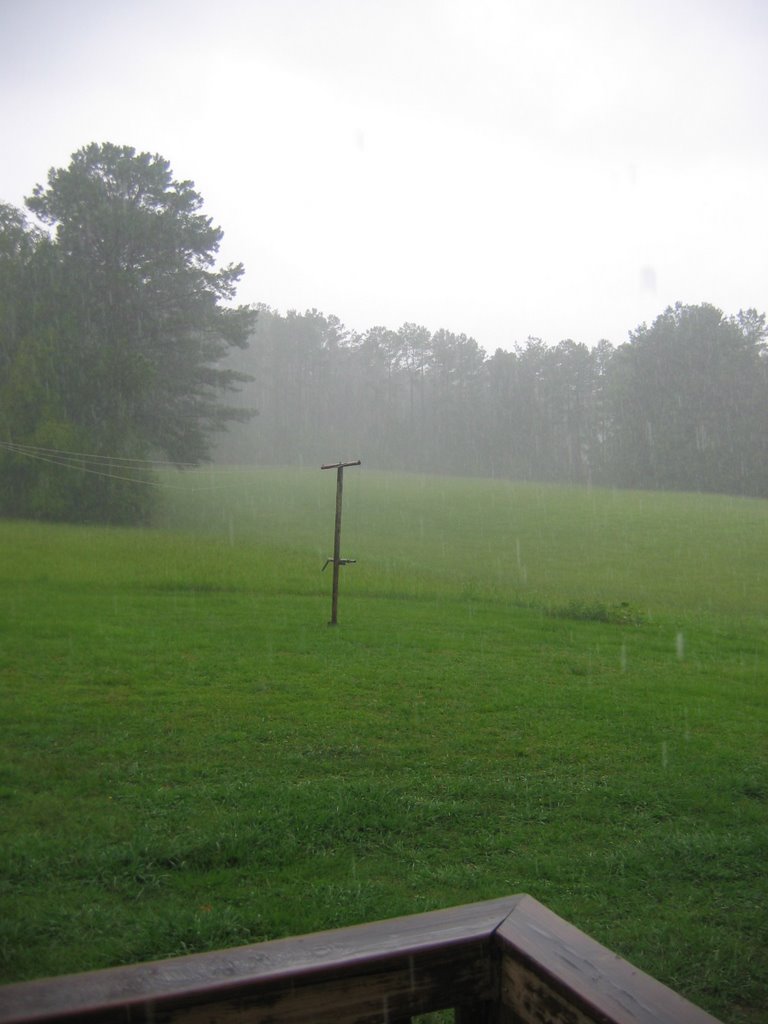


So anyway, here it is, the definitive evidence I've been looking for that Dad, underneath all that external southern babtist conservative genius garb, he's really a hippie at heart too. I knew it! ut then again of course I did, he is me, or I am him, or we are I but I really don;t want to get too technical about it. How funny when lives envelope each other like a Maryushka doll. Me inside of Dad inside of Pop. Bubbles within bubbles. Beautiful, miraculous bubbles. Dear Heavenly Father, thank you for my many blessings, Amen.


2/3/68
Dear Mom and Pop,
Its Saturday morning and I haven’t anything in particular to do, so I thought I’d write and let you know everything is going fine up here. Mom, all the boxes of goodies finally got here this past week, one from you, one from Mrs. Fulton, and one from Granny. Also, Lloyds “tux” got here. Most of the cookies were stale, but the fudge lasted about two days.
I guess you know by now that Dawn has been accepted at Gibbs, and we’re both pretty happy about it. I just “let go” and sent her a dozen roses and a congratulatory telegram. My books didn’t cost as much this semester as I had expected, so I had a little extra money to “blow” anyway.
My courses this semester are radically different from last. With four economic courses, I got pretty bored; so this semester I dropped two Econs. And picked up a Philosophy and a Political Science. Both of these courses are taught by professors who are absolutely tops in their fields- Paul Weise, philosopher, whose course is titled “Nature, God, and Man”; and Professor Westerfield, teaching a course “American Foreign Policy since 1940”, is also outstanding. Pop, by the time I get home this summer, I’ll be much better able to support my side of our “political discussions”, so be ready. The entire course is centered around The Cold War, our relations with Red China, Korea, and Vietnam. However, Westerfield himself is an avid Hawk, so he will probably influence my own feelings in that direction. But, as of now, I still feel the war is immoral and an act of American aggression and imperialism, and it would upset me tremendously to have to go over and take part in it in a couple of years.
As you possibly can tell, Bob and I have been doing a lot of serious talking these past few weeks, and he has convinced me that my goal at Yale is not to “Learn how to make a living”, but to “Learn how to live.”
In the meantime, as soon as that w-2 form from Gulf States comes, send it on up, for I’ll need my income tax refund before I take off to Missouri this spring.

Love,
Allan
 

Blog Counter