Saturday, July 08, 2006


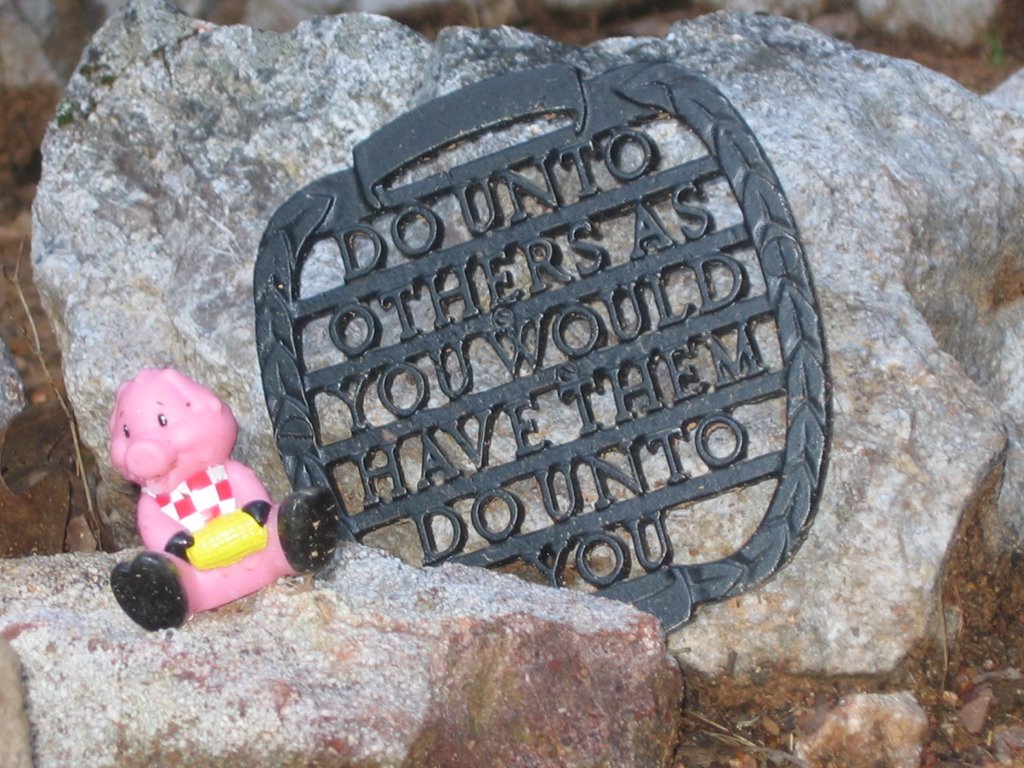
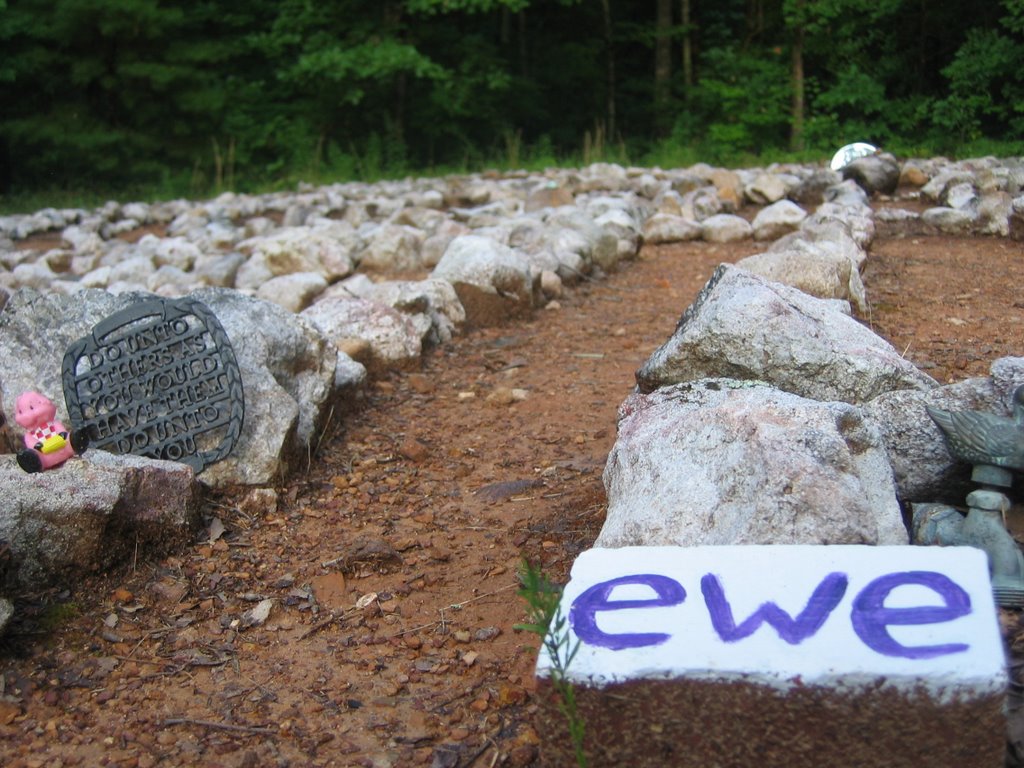
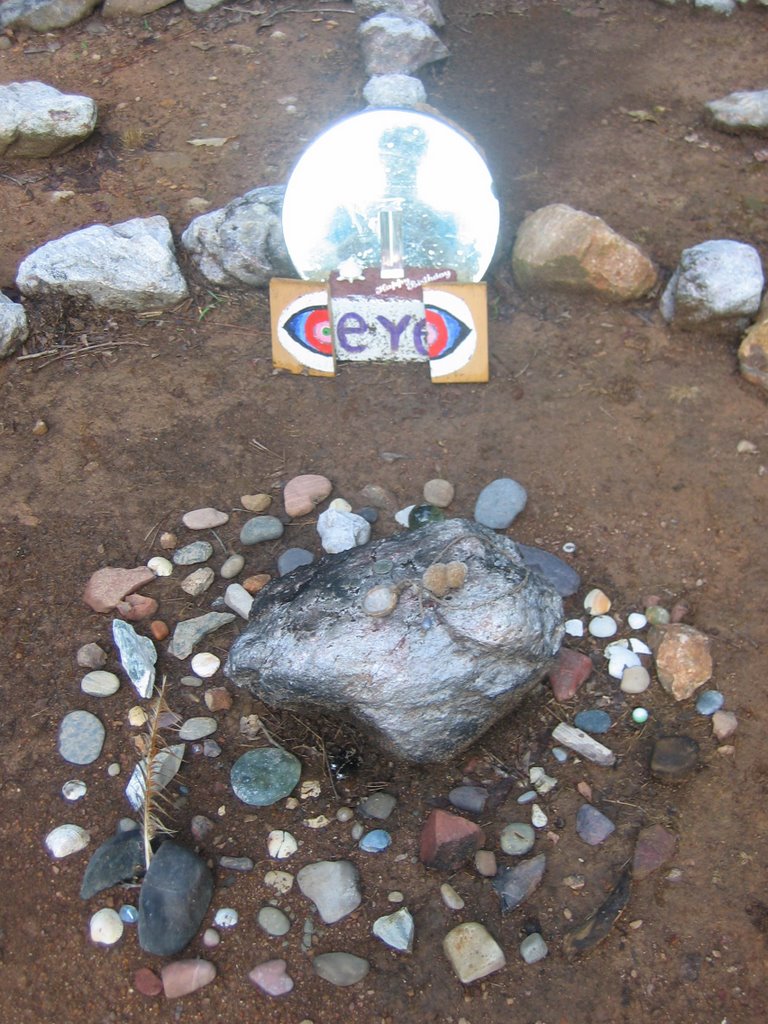
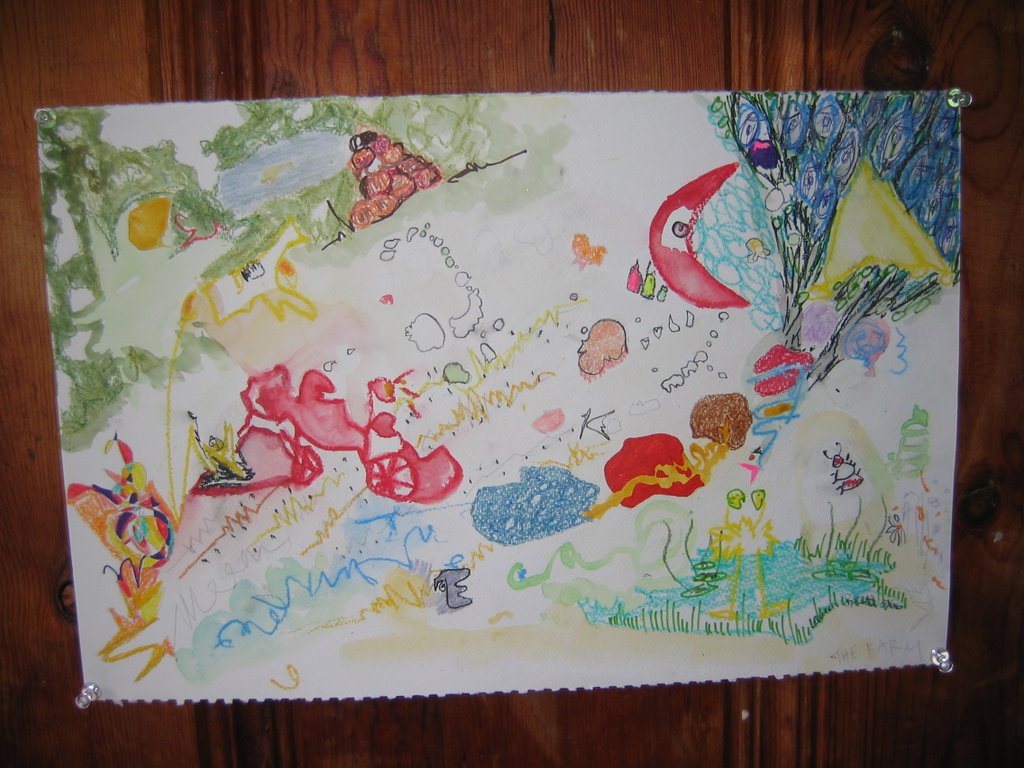
lauren's art show at the farm opened today

attic gold


Friday, July 07, 2006

morphic units, the head of a paradigm


Grandma talk today:
Grandma remembered how she used to get the boys matching outfits to wear to school and did the whole twin gig until they came home and said, “Mama, people down here don’t dress like this,” and that was that, she said. “Shooooot yes, we took care of that.” They got themselves some blue jeans and whatever everyone else was wearing. They didn’t want to stand out anymore than they already did. She remembered them saying how they would have trouble with the other kids standing in the lunch line because people would, “Bless them out,” thinking they cut in line or went through twice. People didn’t know there were two of ‘em. Not to mention that they lived outside of town on a bus next to their house.
Grandma told me they split the boys up to take a test one time, each in a separate room, and both of them only missed one single word on the whole exam and it was the SAME WORD! I’ve been reading about morphic fields and morphic resonance and hearing this story I am reading about formative causation in a whole new light. Do twins pull from a collective memory? Do species pull from invisible but collective banks of habits?

Morphic field: a field within and around a morphic unit which organizes its characteristic structure and pattern of activity. Morphic fields underlie the form and behavior of holons or morphic units at all levels of complexity. The term morphic field includes morphogenetic, behavioral, social, cultural, and mental fields. Morphic fields are shaped and stabilized by morphic resonance from previous similar morphic units, which were under the influence of fields of the same kind. They consequently contain a kind of cumulative memory and tend to become increasingly habitual.

I tried okra in my eggs this morning. Pretty good but you gotta simmer them with the sweet corn and the onions in the skillet before you put the eggs in. Flavor it up with a little bit of basil or Butt Rub too, slow cook some bacon in the skillet next to it and you’ve got yourself a wonderful start to the day.
Have you ever noticed the flight pattern of a mosquito that’s buzzin’ in your ear and around your head and never seems to stop or stay still or repeat itself? I find that my point of awareness, that dot of focus that is the 7% of my brain I use at any given moment seems to bounce and dart around much the way that stupid mosquito does. BZzzzzZZzzzzzZZZzzz. From thought to thought to feeling to observation to hunger pang to thought to revelation to guilt trip to thirst and back to the bathroom and the thoughts in there. Always back to the bathroom, and sometimes in the shower. Now the shower I like because I can keep myself paying attention to the water, and even though that’s not one thing it’s still all over and enough to keep my mind on point, Aquapoint.

------------

Gone
Joack Johnson

Well look at all those fancy clothes
But these could keep us warm
Just like those.
And what about your soul
Is it cold
Is it straight from the mold
And ready to be sold.

And cars and phones and diamond rings
Bling, bling
Those are only the movable things
And what about your mind
Does it shine or
Are there things that concern you more
Than your time

Gone going
Gone everything
Gone give a damn
Gone be the birds when they don’t want to sing
Gone people
All awkward with their things
Gone

Look at you out to make a deal
You try to be appealing but you lose your appeal
And what about those shoes you’re in today
They’ll do no good
On the bridges you burnt along the way

You’re willing to sell anything
Gone with your herd
Leave your footprints
And we’ll shame them with our words

Gone people
All careless and consumed
Gone
Gone going
Gone everything
Gone give a damn
Gone be the birds if they don’t want to sing
Gone people
All awkward with their things
Gone

Thursday, July 06, 2006

just because wild cat's don't have litter boxes...


July 6th

Porch Talk:
Grandma told me this evening about how she was sitting on the porch watching the stray cat that seems to have adopted itself here for a long time this morning. She said she watched him dig in the ground for a good long while and she couldn’t figure out what he was diggin’ for. Then she realized what it was cause he went and sat right on top of it and (see Grandma doing a visual in your mind’s eye right here of the cat going from digging to sitting on top of the hole it dug for itself) “And it did a job!” she says. “Funniest thing about it was the way it sat up on its hole like it did (she does the cat-pooping-in-hole imitation again).”
Now that’s funny. Funniest Grandma moment I’ve had this week for sure. The look on her face as we were laughing, priceless. Then she goes on and says, “Yeah! Then he covered it right back up and I thought, ‘Golly I could step in that!’”
The cat seems to have been getting some loving from somewhere because he gets more and more brazen about coming up to you for a rub or a pet every time. He started rubbing on grandma’s leg and she was so funny talking about how she didn’t want to be mean hearted towards you cat, “but I don’t want to pet you cause I don’t want you to stay. I wish I could just give you some food and have ya be on your way!” Rolling laughter, my gosh if you know Grandma you know what a delivery that story had when she told me. Gosh, so good.
Oh yeah this is the other great grandma comment of the day!
The turkey’s, come to think of it, have been missing from the fields for a few weeks. I hadn’t really thought about it until Grandma said something though. We used to see them everyday and then they’ve been gone for a bit, but today I saw them out in the field again, but this time there were two big turkey’s and four little ones. I told Grandma that I’d seen the turkey’s today but there were two big one’s and four little one’s and she said, “Ooooooooh, so that’s where they been, makin’ babies! I been wonderin’ bout them. They must have a nice home back over there in the woods, that’s where I always see ‘em.”
She was so delighted. Life on the farm, you just can’t stop it.

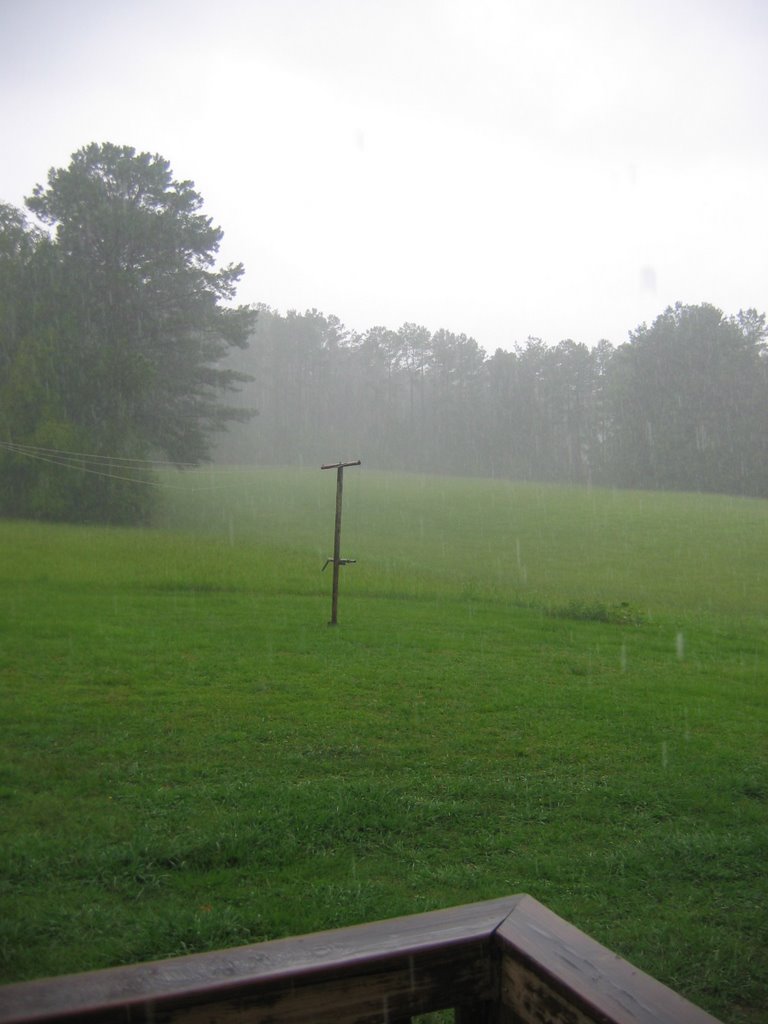
There was a really big storm today, finally really let out some hard rain for a while, but afterwards it cleared up and the sun came out just in time for a bright exit into sunset and life was especially pretty we commented. The fields seemed to glisten in the rain and the bright sun and all the birds and bugs were singing after the rain too. The hummingbird is hanging around the porch again too. Hummmm, I wonder…

the more you know


More gold from Grandma’s digging. Somewhere in one of Pop’s files she found out where he or someone else had typed out a short little two page history of Columbiana. It’s a small little place but it’s a good one, so if you know it, now you know…


The History of Columbiana

The City of Columbiana is in Shelby County, Alabama. It is the county seat of Shelby County. Shelby County was named after Isaac Shelby, Kentucky’s solider-governor who had been a Revolutionary War hero. He refused election to a second term as governor in order to fight in the Indian Wars. Although Shelby County has not had a very exciting past, there are a few incidents and people that are outstanding.
Most of the early people of Shelby County first lived in Montevallo, Wilsonville, and Harpersville. They originally came from Tennessee and Kentucky. The people who first lived in Columbiana moved in from Wilsonville and Harpersville.
In 1826 a county-wide vote was taken to decide whether the court would be moved from a little log courthouse somewhere near Pelham to Columbiana or to Montevallo. Columbiana won the election and to celebrate, the people made use of a large pine tree, since they had no guns, bells, or whistles. The citizens bored holes in the tree and filled it with powder. When touched off, it made a report which was heard in a four mile radius.
There are no old houses or ancient landmarks in Columbiana that date back earlier than 1820 because titles were not granted by the government until after 1821. Early white settlers held their land by virtue of what is known as Squatter Sovereignty. Also, there was the fear of attack by marauding bands of Indians who occasionally made destructive forays into the county. The settlers dreaded constantly having their possessions burned or stolen.
When government land offices were opened, farmers and others rushed in to supply for receive title of the choice lands. They then began improving their lands and by the 1850’s there were many fine houses around Shelby County and Columbiana. One is the home of Mrs. W.W. Wallace; one is the old Leeper place built in the 1830’s by judge J.T. Leeper and now owned by Harris M. Gordon, and the third is the original home of Jefferson B. Elliot and now known as the Bolton-Walton Funeral Home. William Atkin and Joseph Howard were the first comers to Columbiana. They cleared the land on which it now stands. When Columbiana became county seat in 1826 the Court House was established in a framed school building and remained there for 28 years. In 1854 a red brick building of more permanent nature was built on the same site of the school building. This building proved inadequate from the start. The building originally cost $2, 500. It included two large rooms, two smaller rooms in front of these, and one large room on the second floor to be used as a court room. The two larger rooms were used as offices for the Judge of Probate and the Registrar of Chancery. The two smaller rooms were for offices of the Sheriff and the Circuit Clerk. In 1881 alterations were added to complete the building. Added was a grand jury room in the back of the building and a vestibule in front. Several years later two small vaults were added in some of the offices.
Judge James T. Leeper was Judge at the time of completion.
This building remained as the court house until 1905 when the Court House was moved to its present site on Main Street. This new structure cost $300,000. It was built of Georgia marble. When the county outgrew this, a brick annex was added to the rear of the Court House. It contained offices and a jail on the third floor.
The first jail was on land located near the present L $ N railroad station, This gave place to the red brick jail on White Street. It was vacated in 1955 when the prisoners were moved to the new jail above the Court House.
The Town of Columbiana bought the old brick court house for $5000 and converted it into a City hall. Before the new City hall was bought, the offices were in a small structure on White Street that was built during World War II. Later it was enlarged to house the fire department and wil continue as the Fire House.
Among the men of affairs who were large land holders and had a prominent part in the development of this part of Alabama were: George Phillips, chief justice at the fist court held in Shelby County; Bennet Ware and Patrick Hayes, other justices at this court; Jacob Lawler, the presiding judge when the court was moved to Columbiana in 1826; Wiley H. Pope, Robert Bowden, Rubin Mardis and his two sons, N.B. and Samuel; Joseph Roper, Alphonso a Sterrett, Benjamin Wilson, David and George M. Mason, the Nelson family, and others. Many of the earlier settlers left the area before and after the War between the States. Some had been leaders in its early development but decided to try their fortune in Texas or farther west. Others went to Birmingham to acquire wealth and distinction.

Wednesday, July 05, 2006

the duo


"hey, what's that on my shoulder?"

Tuesday, July 04, 2006

The Clipboard


Glowsticks, roman candles, artillery shells, 15 foot fire pit, labyrinth, sweet tea, scrambled eggs, scrambled eggs with sweet corn and onions, waffle house, crickets, fire ants, bluebird houses, the bridge, hay bales, boxes of photos, the picture glass window, the porch, the fields, the E-Z-Go, the trees, the hills, tiki torches, green glass marbles, guns, sawhorse, watermelon, waterproof wicks, grandma, icee pops, neighbors, pink flamingos, tin roofed barns, hot rain, bow and arrow, majitos, soundbites, fear, truth, functionality, memory loss, stupid people who love being politically correct, subconscious, uberconscious, unknown factors, white coats, lies, time, space creators, money, greed, flashlight, gong, fire, ripple, lake, creek, drum, orbs, family, patterns, deeper patters, life cycles of bugs.

Is/was Self I am/will be


How many July fourths can you remember? I remember the one I went to see Phish in Philly that year, that one in Germany, the Cheese show in Steamboat, a few at the farm, one at camp… these are all out of order but I’m free to remember them any way I want aren’t I? Aren’t you?

So I’ve been invited to attend Sunday school with grandma on Sunday and being the religious studies expert that I am (ha ha ha) I’m so – excited? Is that the word? Grandma hasn’t been to church in a good long while since Pop had his stroke and couldn’t attend himself, so it’s a really good thing I think for her to start back, the community missed her. She went this past Sunday for the first time in a while and seemed to really enjoy it from what she said. What she really enjoyed was when she talked to Pastor Miller and told him that I was going to come next Sunday and he took a personal interest in it. As she was leaving he told her he was looking forward to seeing me next week and that he’d like to show me around personally. Oh boy, what did I get myself in to? I hope it’s something deep, I think it is, in a not too deep way. Chuckle. I want to be careful not to sound aggressive when I ask the questions I’ve been asking about the Bible and Christianity for some time now, the fine and subtle points I learned to pick on when I studied religion as an academic. I want to be careful because I’ve been doing that sort of questioning for a long time now and it gets to a point where you start to wonder if my exposure to so many different sets of truth has turned somewhere along the way to have a type of gridlock, paralyzing effect on me. In a way I worry I sort of flooded the system and lost touch with my original motivating force which was to dive into the deepest hardest brightest truths about life and perhaps religion was just another deep pool of water search through to find who else knew to love God, to feel God, to be in touch with God in all aspects of nature, without, of course, being naÔve about the hokey pokey sheepherder stuff. I know that I am in touch with God, it is the underlying principle that allows the proposition of the question to even be possible in the first place, which it is since we are asking it. Get it? It’s more than a principal really, because it’s a known. That I know God exists is my bedrock, but now what exactly God is or looks like or where the boundaries between me and God or God and me are, those sorts of things are still out on the table. Every year it seems I need a bigger table to lay out all the new things pointing towards the character of God and me I come across, and at some point I want to simplify. Clutter is for confusion, is for the search and the collecting of data, for opening up space or Providence to hook together the non-linear self-evident realities of it, but how long is that going to go on? You can’t think your way to happiness, God is not an intellectual lesson to be learned, it is, it is, well what is it? He? This? Us? You? I? The? Am? Really, what is the arrival of an understanding of God like? This is not a rhetorical question people, I’m really asking you, what’s it like? Tell me about it, please. I need something smart to say on Sunday…

It feels like I’m getting defensive about something. An output of some sort? Input? A clog? A clot? A kink? An opportunity to have a better flow? How do I look at it with most Quality? Most truth mixed with most uncertainty? How does one live on the cusp of the wave? When you get away from it you just think you’re getting away from it. It’s just for a moment you think it’s vaporized itself for something and you manage to fall back asleep and then it’s a week later when your baby gets stuck in traffic and you turn irrational again and fail to make the rational connection to the illusion you had of getting away from it. It can get bad.

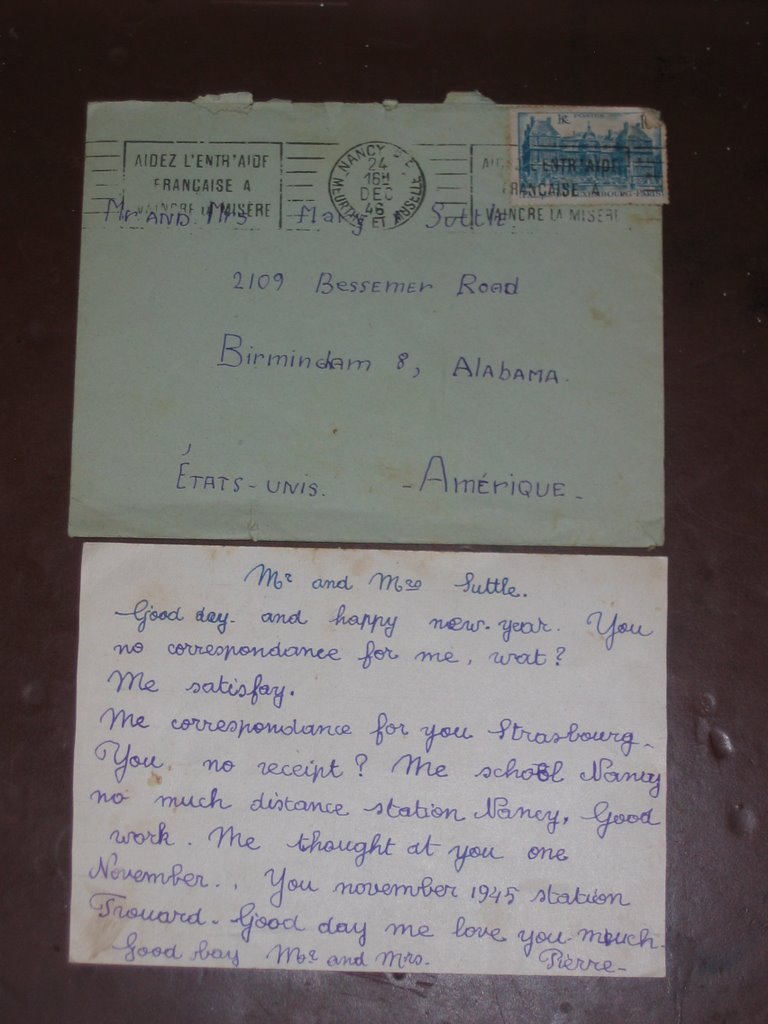
Pierre


Grandma has been spending a lot her time going through old letter's from pop during the war and such and today she found a letter from Pierre, the french boy Pop kept in touch with. The pic is above and i translate below as best i can. Language is so funny...

Mr. and Mrs. Suttle.
Good day. And happy new.year. You no correspondance for me, wat?
Me satisfory.
Me correspondance for you Strasbourg. You no receipt? Me school Naney no much distance station Naney. Good work. Me thought at you one November 1945 station Trouard. Good day me love you much.
Good day mr. and mrs. -Pierre

The Miracle Bubble Metaphor


follow me now...

Every bubble has a direction set, a floating point of center, a subjective equilibrium.

One set from one center and these are: North south east west up down in outside inside before during after, don’t you agree? Did I miss any? Sketch it out and see, I may have. Draw a quick bubble and label all the directions it could go if you were a point of awareness in the center of that balloon. Did I miss any?

Could you say everybody’s head is a bubble and that same set applies directly?

Is that set a whole set? A universal set of characteristics that every human being has? No matter if you’re black, white, brown, red, yellow, smart, stupid, pretty, ugly, funny, obnoxious, preacher, sinner, saint, toad? Seriously, isn’t this a universal set of characteristics every human has, to varying degrees probably but still, it’s a universal set, am I wrong? Tell me if I’m wrong, please, I need to know.

Dare I say
In any moment of time
Every subjective awareness
Has these possible directions to go:
North South East West Up Down In Outside Inside Before During After.
Period?

Can you image what I’m saying here?
Do you get it?
Does it make sense?
What keeps you balanced and centered?
What holds you together?
What does the earth’s gravitational field look like?
How many miracles can you fit in a bubble?
How many miracles can you fit in your head?
How many bubbles does God blow?

Blow a billion bubbles
Blow just the perfect one
One is for the town you know
One is for your son
One is for your sweetie too
One is just for you
But Blow the biggest bubble for God
It’ll give you more of a view.

What links us all?
The Universal Direction Set…
…call it a Super Bubble Miracle Set why don’t ya?

Monday, July 03, 2006

Mind the Gap


Cole Suttle
December 3, 2003

The largest hurdle for the philosopher is to find a way to explain the existence of both Objectivism and Relativism in a single theory. To somehow link the paradox of separateness and the apparent inability of the subjective experience to be compared objectively. The unification of the part and the whole is the task of the modern philosopher because it is the apparent separateness of individuals that is restricting the coalescing and harmony of the whole. This attempt to search for the meaning of life will be based on the premise that whatever the meaning is it must account for both the Subjective and Objective side of Truth and not exclude either/or on account of trying to keep it clean cut. By focusing on the relationship of the individual to the community I will try to find common ground between the eastern and western ideas of self realization and see if the problem is more one of semantics than ideologies.
The question what makes life worth living? is a fundamental jumping off point for the sincere adventurer looking to find some sense of value or worth in their awareness of their own existence. I use the word awareness because what is value or lack there of but an awareness of something? Going even further, what is it that shapes, creates, unfolds that awareness? Owen Flanagen begins with the question what makes life worth living and examines its assumptions and the problems it brings rise to when accounting for the meaning of life. Though I’m content with the mentality of Flanagen’s conclusions, his choice to attempt a theory that includes everyone restricts him from being very detailed. The way to the meaningful life in one cultural context, China for example, might not sound the same as in another, America for example. Where he lacks practical advice leaves room to look elsewhere, even inside for specific guidance. With that in mind the practical advice cannot be introduced into this paper until after Flanagen’s argument has been laid out.
Beginning from a very base, literal view Flanagen takes living to mean, “time spent not-dead.” (pg. 198) Aware of how reductive this definition is, Flanagen follows the discomforting implications of such a view to hunt down what makes a life lived, lived well even, different from a life spent not dead. What gives life value? What brings about a subjective awareness of truth, be it an objectively reliant awareness or ultimately entirely personal?
Using the example of money, something which has no value until it is assigned by us (the individual and the social setting) to have worth, Flanagen claims that material value comes short of explaining where the meaning of a life well lived comes from. The wealthy Sultan cannot be said to be living a meaningful life strictly on account of his possessions. Happiness, something more personable and closer to the heart of things, does not justify the origin of worth in a life either. Even a life chock full of happy moments doesn’t necessarily validate a life well lived. “Properties of parts do not confer the property of the whole. My parts are small, I am large. Happy times, even many of them, might not constitute a life well lived.” (pg. 199) Though Flanagen does not say the meaning of life is absent of happiness, he is cautious to point out the danger of relying too heavily on the subjective standard of happiness as a measure of the meaningful life. This is the Hitler question and the crux of the Objectivism/Relativism struggle, could Hitler have lived a good life if he was happy and thought he was doing something of personal value? There is something that grossly violates typical human intuitions about resolving to admit Hitler lived a good life because people simply aren’t willing to trust their guts.
What then, if material measures have value only to the extent it is assigned to them, and strictly subjective scales of happiness appear too vague and dangerous to be the end all aim, gives life meaning? Where is the middle ground? Flanagen argues that though Happiness is commonly thought of as a crucial component to the good life, there must be something else that validates living a life of worth. In an effort to link the western idea of individualism with the eastern philosophy of transcendence, Flanagen claims it’s the finding and creating of an identity and the expression of that identity that is the aim of the life lived opposed to the life merely existed. It’s one thing to claim life has meaning in the discovery or invention of an identity, followed by the expression of that identity, but how does one go about doing so? Flanagen chooses to speak in broader terms so as not to alienate the capacity for only certain types of self’s to fulfill this action, but falls short of providing the practical advice people need. Though this is intentional on Flanagan’s part, what good is a theory about the meaning of life if it’s not applicable to everyday people here and now? I’ll leave that until later.
Flanagan argues that though self and self-expression are not all that is needed for the meaningful life, they are indeed necessary. “If something-if anything, that is-is necessary for a life worth living, it is this: that I develop an identity and that I express it.” (pg. 200) But how does one go about developing an identity? Flanagen argues that it is as much the community as it is the individual that allows for both the creation and the expression of the self. To find an identity and express it requires a social canvas, even for the aesthetic monk who decides to leave the social structure for their identity, because there must be socially established expectations in order to transcend them.
After establishing that it is the creation and expression of an individual self within the context of a communal group of selves that gives meaning to life, Flanagen goes on to defend the reality of individual selves, or subjects as he refers to them, at all. This is where he bucks up against the Buddhist philosophy of no self. The eastern idea being that suffering exists only because we falsely identify with our self, and thus believe that when Cole Suttle is hurt I am hurting too. But why think there are no subjects? Flanagen asks, then breaks the arguments into three: the metaphysical, the sociological and the developmental understandings of what the self, the individual subject really is or isn’t. (pg. 201)
The metaphysical claim is that I am merely a set of eyes, but the vision and the ability to see is not my own. I am merely a “location” through which the infinite complexities of the universe collide for a moment’s awareness over and over again. The sociological argument claims that “I” am merely a schizophrenic actor living out a script society wrote for me. “I” exist only as the meeting or falling short of the expectations my community provides for me. There are only parts, but no legitimate middle sphere of unity that ties my “I” to anything separate, stable and distinct. The developmental perception of “I” is the old clichÈ that nothing is real but change itself. Any perception of myself as an individual, separate from the whole whose boundaries I cannot see, is merely an illusion. I am constantly changing, mind body and soul, and so to claim there is a representative center somewhere is false. Who I am now is not who I will be in five years, or whom I was five years ago, therefore I as an individual must not exist.
After laying out these arguments against the “Death of the Subject” as Flanagen calls them, he proceeds to slyly portray the assumptions each argument makes but ultimately don’t prove much of anything. (pg. 201) His personal strategy (because all we have in the end are personal strategies), is to accept that yes, subjects and individuals do change. They are always changing, on levels and planes beyond the everyday dimension of existence people are commonly aware of, but that hardly proves the false existence of individual subjects. As for the social role he admits this is true to an extent because before the individual gains control of their self-expression they have limited powers of free will. Growing up for instance, people merely fulfill roles society has for them without being aware of what they are really doing. But “being constructed hardly makes something into nothing.” (pg. 201) This argument merely shows that some are sheep and others are herders, and that there is a process of transition somewhere between those two that gives life meaning. As for the metaphysical argument, Flanagen draws on the assumption that to serve as a set of eyes, a point of awareness, is the effect of a cause, but every effect in turn sets off another cause, and thus another effect. So even if the subject is a constructed prism, it is fulfilling it’s instinctual desires actively, therefore setting off ripples that will in turn shape other “locations” etc. “Furthermore, the fact remains that evolution has resulted in the existence of organisms that have temporarily extended lives and are self-organized and self-moving in certain well understood ways.” (pg. 202) The direction of this movement is the concern, how do we know what’s moving in the best direction? Is it this movement that distinguishes the life lived from the life spent not dead?
Once Flanagan has safely secured the assertion that subjects and selves indeed exist on their own account, he has branched off from the Buddhist perspective that there are no selves, only constructed illusions of separate pieces of the whole. What Flanagen goes on to do is test the worth of a subjective value that exists as a result of an objective shaping, i.e. the village. He gives two scenarios, one of the belief in an omnipotent, perfect, all-loving, all-powerful Western sounding God vs. the almost Gnostic idea that the original force was an irrational one that wound the clock just before the big bang and then stepped aside afterwards, letting creation account for itself. Though these stories appeal differently to different groups, Flanagen is not content with their conclusions. They leave only an either/or option, not a theory that explains the existence of both an objective and relativistic perception side by side. To separate truth between individual and the whole is to miss the point.
The problem with the omnipotent God story is that it passes the buck by saying whatever happens is God’s decree and the individual has little say or value in the outcome or the shaping of the outcome of something so meager as I. This is why I find it strange when believers in this idea still claim free will. As if they are able to pick and choose what they are responsible for and not lay claim when bad things happens. As for the second, reductive scenario, Flanagan pulls in Nietzche and what sounds somewhat like Sartre in an attempt to take the responsibility away from projecting it onto an unexplainable omnipotent, all-loving, all-powerful God and onto the shoulders of the individual. As an individual, a real self capable of creating and expressing the best and worst of things, it is not the responsibility of some exterior God to make meaning of one’s life. It is the responsibility of the individual to create an identity with which to relate to the world and find value, which in turn is then expressed back into the world. A symbiotic, reciprocal system. This is a very important and self-empowering part of Flanagen’s theory. For the good life it matters very much that the individual apply themselves to their decisions.
Flanagen’s conclusions champion the meaning of life being in the relationship of the individual to the whole- other individuals or a more transcendent God. Ultimately value and worth come from the creative rendering of an identify using what the individual experiences internally as a result of the external world, but this is not to strip away the existence of the value of what the Self has to say. It matters very much what I say and do and want. (Flanagen pg. 204) Though rough an unrefined, Flanagen manages to fit the role of both the objective and the relative truths into a single idea for the meaning of life. He places, like Sartre’s existentialism, the responsibility for creating a life worth living on the individual, daring them to trust themselves and recognize their own identity, and then calling on them to express that identity creatively back into the big pot of existence. He paints the picture of an evolutionary community that feeds off each other, organizing and then reorganizing again and again as more material to be creatively painted with comes into awareness. Though he validates the worth of the community as w hole, he does not allow that to take away the value of the individual subject Science is an example of such unfolding truths that can be applied to the before to create an after, more aware perception. What is important is to remember science is only a tool that one day will need to be discarded for something that transcends it. Because there is a flow, a direction of movement in this evolutionary picture, it leaves open if not downright encourages the possibility of transcendence. “This is a kind of naturalistic transcendence, a way each of us, if we are lucky, can leave good-making traces beyond the time between our birth and death. To believe this sort of transcendence is possible is, I guess, to have a kind of religion.” (205) Is he saying humans are inescapably religious? What sort religion is he talking about that includes everyone? And luck, what sort of luck is he talking about?
One thing Flanagen seems to have constantly in the back of his mind is speaking in terms broad enough to account for everybody, everything; Nietzcheans, Libertarians, Buddhists, and Benedictines. (pg. 200) This choice, though productive in that it ascertains a.) the reality of individual subjects not dependent or shaved off some Higher, all inclusive single Soul, and b.) empowers the individual to trust all facets of themselves and the weight of responsibility to do so, ultimately lacks the practical advice many are looking for. How does one create an identity? How does one create the best identity? How does one express that identity? But before we delve into the practical advice of other philosophies, let us scrutinize Flanagen’s assumptions more closely.
The philosophy most closely related to a self-transcending meaning of life is the Buddhist philosophy which rears around simple statements such as, “so self, no problem.” (Kornfield pg. 12) Flanagen claims that his naturalistic transcendence theory incorporates the Buddhist ideals as well. Does it?
The Buddhist idea on how to live the meaningful life is to lose any identification with the individual self, Cole Suttle in my case, and fall into a connection with the larger nature of things, Buddha nature. Buddha Nature is the underlying fabric of all existence and as humans we become disconnected with this nature and suffer as a result. This philosophy is based around the almost Hedonistic idea that the best life is the life lived without suffering. That it is suffering which holds back the good life. Susan Wolf would disagree with this because she believes it is indeed the characteristics and variety of different selves that make life rich and worth living. This is why the Saint that gives up everything is only so appealing to normal, everyday people. To focus completely on becoming numb to the world, as it appears from some angles Buddhists do, is to miss the point of life she says. It would seem Flanagen might agree with Wolf as well in that he believes life is meant for expressing our selves as opposed to attaching to something established and hiding under it as giving your life meaning, when in fact its meaning is merely being fed to you. How then, can Flanagen claim to account for Buddhist philosophy in his theory and agree with Wolf at the same time?
There is a bit of word play when one reads Flanagen’s definition of the meaning of life to be for the self to identify with an identity, and the Buddhist idea that any identification with the self is the root of suffering, and thus the restriction of the best life. What are the ends of these two ideas? For Flanagen he is aiming at self-expression, a broad dynamic goal that does not end and is not achieved absolutely and finitely. For Flanagen it is a pure developing not a possessing that is important in the good life. It varies from identity to identity, but is no less more real or less real for those who do achieve such a state. For Buddhists the aim is enlightenment, which I dare say is synonymous with omnipotence, a transcendence of individual worries and restrictions and the dropping down into the void where all is said to begin and return to.
The reason Flanagen’s theory can coexist with Buddhist philosophy is because he doesn’t get explicit about what sort of identity need be created, only that creativity plays an important role. What would Wolf say about a person who does their best to emulate the saints in an attempt to create their identity and transcend their earlier limitations and doubts they have that the life of the saint is possible for them? Is Wolf a pessimist? It would seem the Buddhists too revolve their struggle for enlightenment around the problem of dualism as much as Flanagen does. To achieve that state they work towards tearing their awareness away from their individual characteristics and identifying with an omnipotent self, which they don’t call self at all. It is a stripping away of what they consider to be the illusion of our identity and reconnect with Nature and their place in it. Is the Omnipotent self an identity to be reached, and then expressed omnipotently? Can we, looking out from our uncarved, rough self centers of awareness pretend to know how an omnipotent self expresses itself?
This I feel is the link between Buddhism and Flanagen’s more cautious western self-realization philosophies. This is the unification of the two examples Flanagen sets up between the idea of an all powerful, omnipotent God and some sort of scientifically measured original force that set the world in motion. Perhaps the meaning of life is to emulate the God/Nature idea, not fall back and rest in the myth of his perfect existence. Perhaps God/Nature is not looking for the sheep that want to be led and not have to worry about their own sense of value, instead God/Nature wants those people willing to jump in the trenches and fight for a better way using the gift of themselves. The transcendence Flanagen talks about is a sort of surrender to the identity that the self winds up finding. If that identify is so large and all encompassing that it’s self-expression is to become more of a channel than a conscious, individual creator, then the meaning of life is indeed to surrender to the flow. But the flow of what? What channels through the omnipotent self?
Again, what is lacking is the practical advice one might follow to achieve this ideal state. For westerners the Buddhist ideas of desireless living and self-restraint may seem foreign and too unnatural to lay much credence in. But if we look to the ancients, Epictetus’ Guide for Living with peace of mind begins to ring a bell as possibly being the secret guidance that also allows for a link between the internal and external world. A mindset, an attitude to approach life with that encompasses the whole and doesn’t invalidate the variety of differences within it.
What does Epictetus tell us is the best way to live life? The underlying staple of his philosophy is to adopt the mentality that it is only worth worrying about those things we can control. “In our power are opinion, movement towards a thing, desire, aversion, and in a word, whatever are our own acts: not in our power are the body, property, reputation, offices, and in a word, whatever are not our own acts.” (Epic pg. 11) In the dualistic existence it is easy to become dismayed by bad fortune or ill acts by others, but to sacrifice inner sanctity for emotional reactions to those sorts of things is to forego one’s personal power to control the way they relate with the world. As Flanagen says, “If meaning and worth come with relations of sorts, perhaps in the first instance to other selves, but possibly also to nature, to work, to oneself, then perhaps we are wisest to look for ground of meaning and worth in this life- in relations we can have during this life.” (Flanagen pg. 204) The meaning of life for both these philosophers is in the way the individual creatively creates a relationship with the whole through the Medium of their Self; In the process of building, shaping and living of this relationship between the part and the whole value is found.
“Seek not that the things which happen should happen as you wish; but wish the things which happen to be as they are, and you will have a tranquil flow of life.” (Epic. Pg. 16) But is to surrender to the flow not a leap of faith into the value of that which is flowing? This God/Nature phenomena? The willingness to worry only about what is within the subject’s control, and accept on faith that which is outside of it has enough value to be surrendered to is the “kind of religion,” Flanagen ultimately winds up deeming necessary for his naturalistic transcendence theory. The decision to have faith though is arrived at here pragmatically and not on account of Dogma. Much the way Tolstoi rationally opted out of religious faith his entire life and then wound up deciding after living with the peasants that it is rational to believe in the irrational possibility of faith. To not believe offers nothing but the absence of tranquility, and how can the self fully function and develop in a constant state of unrest? It is almost as if to believe is a natural force in the world that offers advantages not believing can’t. Perhaps belief is the alchemical magic element of the meaningful life.
To recap, and to have a space for ME in Philosophy, I’m going to risk inserting my own words in this paper about what I have learned and come to believe to be the meaning of life. The reality of perceived dualism is the opening quandary that must be reconciled in what I believe is a true theory about the meaning of life. Truth must account for everything, objective or subjective, even if I am incapable of seeing the entire canopy from here. How then, does a person go about reconciling this in their journey for purpose and meaning? I rationalize thus:
Because there appears to be no scientific way to measure and compare Relativist truth with Objective truth, I take on the mentality of Epictetus and resolve that I can only be expected to worry and be held accountable for that which I can control. Though this sounds relativist, it’s not because I do not discount the reality or value of objective truth. What I’m saying is that because the only way I’m capable of accessing Objective truths is through my subjective experience, I must begin by fully tuning my Self before I can trust what I see on the outside. Flanagen draws on the importance of seeing the value of both the part and the whole. The analogy I use is the body. The Subjective meaning of the liver is different than the Subjective meaning of the stomach, or the eyes or the lungs etc., and yet the objective meaning of myself as a whole exists too and requires all of my parts to operate in their own way in unison with one another. I believe it exists because my body is what I travel and associate my self with, though perhaps the belief that I exist at all is a type of religion. That is fine with me because I arrived practically at this conclusion. If I am ever to find an identity and express it I have to start here developing my relationship with the whole.
While using the body as a microcosm for the rest of the world is a wonderful way to fit the objective/subjective schism into a comprehensible image, the meaning of life goes further. What appears to have happened in this world, especially with the advent of the scientific method, is that Truth has been broken down into bits and pieces. Scientists have tried to isolate cause and effects, tried to smooth out the symptoms, but in general have lost sight of the value of a whole truth as opposed to chunky pieces of truths only. In an effort to map out linear cause and effect diagrams the parts have lost communication with each other, undermining the value and vision of the whole. The meaning of life is to find a way to fully identify with my Self, to bring the body, mind and soul into harmony with one another, and then from there, I’m faithfully guessing, to drop into the flow of things. I cannot promise you that when you are fully Whole and communicating with all your parts again, Truth will be what you or I see from here in our disconnected selves. I believe that shouldn’t matter because of course the world will look different when I am in full control of my observation tank, because my current view of the world is in part of result of that tank. Until then my perception of the best and most meaningful is handicapped, but I’m willing to work with what I’ve been given and not pout about wanting more or not having enough. As Socrates said when asked why he was a great man, “I’m not a great man, I’m simply aware of my own ignorance.”
So what then is my practical advice? Dare I say to follow one’s intuition? Is intuition not the subjective/objective force in the universe that allows the person to be plugged into the whole through their parts? Is it too dangerous to suggest everyone follow their hearts? So as not to sound self-righteous this is where I resolve, instead of trying to defend what I have found on my own path, to dare you to get started own your own. The world, God/Nature, is alive and aware just as we are. As you begin to fully communicate with all parts of yourself again the rhythms of the objective syncopate with your subjective experience and the individual awareness begins to pick up on the vibrations of the outside/inside worlds. As this happens, it is my faith and partial experience, the walls and barriers of myself and the incongruities that keep me separate from you will fade away and transcendence will occur. What the world will look like from there is limited only by the depth and beauty of our collective imaginations.
Personally, the greatest piece of evidence I find for believing that there is an innate and beautiful natural drive to transcend ourselves is when I see a child with rotten parents turn out better than the people who raised them. When a child, raised by drunk and abusive parents, in poverty, in a vacuum of Love, still manages to develop a heart so big he has more love than his parents combined I see there is something enchanting and encouraging that from a lack of love comes a flood of love. Is not this the lesson of the Bible? Does not the wrathful, vengeful God of the Old Testament have some sort of midlife crisis by way of returning as his son Jesus, who preaches love they neighbor and turn the other cheek in the New Testament?
Finally I want to remind you that whatever you think of these philosopher’s, or my ideas, they are indeed only ideas; theories created out of the limitless capacity of creativity and reason by other subjects. If you disagree, trust your intuitions and chart your own path, but get to know yourself before you make too many final decisions. Learn from your mistakes, have faith in the untapped powers of the universe that transcend our individual gripping about who can or can’t be trusted. You have to learn to trust yourself first. If you want a theory that applies to everyone it needs to be loose but not reductive. Intuition serves this example. And though it is true people are born with different advantages and disadvantages, some are smarter, some are more beautiful and some are born into wealthy families, what is the one thing that transcends all these things? What is the one thing that does not require anything of the individual to have access to or experience? Love. No matter how dumb or ugly a person is I dare say everyone has the capacity to love or feel loved, if only for a moment. But the moment can be built upon and with training can be sustained. In the end there are so many theories I don’t feel it can be expected of us to find the one and only. As Dostoyevsky said, “Thou shalt love life more than the meaning of life.” Theories aren’t worth anything unless they carry you to a place that makes you and the world better connected, a fuller now. Love is the one universal force that has the ability to cut through every individual barrier, illusion or not, and still be experienced collectively.

Sunday, July 02, 2006


Daddy's flown across the ocean
Leaving just a memory
A snapshot in the family album
Daddy, what else did ya leave for me?
Daddy, whatcha leave behind for me?
All in all it was just a brick in the wall
All in all it was all just bricks in the wall

We don't need no education
We don't need no thought control
No dark sarcasm in the classroom
Teachers, leave them kids alone
Hey, Teachers, leave those kids alone!

All in all its just another brick in the wall
All in all you're just another brick in the wall

I don't need no arms around me
I don't need no drugs to calm me
I have seen the writing on the wall
Don't think I need anything at all
No, don't think I need anything at all
All in all it was all just bricks in the wall
All in all you were all just bricks in the wall

Saturday, July 01, 2006

mystical optimism


I am living in the backroom at the farm with Grandma now, in the room with all the books from over the years and all the drawers filled with the sort of gold only grandparents keep around. Newspaper clippings, invitations, letters home, pictures, medals, the entire 1968 World Book Series. There are pictures everywhere from grandma's parents to Pop's time overseas during World War II when i he was an engineer on General Patton's train, to the boy's and their college years through the boy's and their weddings and then the boys and their boys and then a whole stock pile of photos the boy's sent Granmda and Pop over the years bragging about their boy, and Christen too of course.
I don’t know what its like for you, but for me, digging through these drawers is the most magical thing in the world I've left to do. When you start to bleed the whole me and you duality together, the concept of family takes a leap in cognition as you begin to wonder what the difference between you and you father, or grandfather for that matter, really is. I mean, you came from inside his head, that’s crazy. And once you’ve gotten comfortable with the idea that our self is not nessearily defined by our phyisical bodies alone, where does the self find boundaries’ when you are staring into your grandfather’s face as his body shrivels with cancer and old age right in front of you? Back into the earth. Everything goes back into the earth. How are you supposed to feel about the fact this is the second time you've looked into that shriveled face that is almost your own, and that was when your father died of cancer way too young. Pop’s son, and here’s Pop going to meet his son whose already been across, and here’s me, Pop’s son’s son trying to hand him over to Dad as best I can. Experience is the only real teacher right? I suppose I should put that sort of experience to good use, like doing it again with all the things I've been realizing hindsight 20/20 for 3 and a half years. Here it comes again, hope I get it right this time.
Get it right. Get death right. What the fuck does that mean? I'm sure it means something. I'm sure it means a lot. I’m just not so sure I know what it means for sure, but I’m pretty confident I know what it means at least a little bit. Maybe even more than w little, but who knows? I want to stay humble about the extent of my oh so valued death-experience-meter and all, but I think I squeezed a little something out of it since the last time. I think I can learn to appreciate this everything must be born just as it must die phenomenon, but I’m not sure it’s in the same context as you. Not that it’s in a better context, it’s just that it’s my context. It’s my lesson plan I put together when I kept waking up and you really were gone. It’s all the things I say when someone else is talking about their Dad or something, all the things I say inside my head to stay cheery and remind myself to be brave and look for meaning. Oooh meaning, how fantastic. Now I’ve got something even better to tell myself the next time I hear about your family vacation.

That was all a ramble really. A lead up to the gold bar I found in the back room yesterday. It's a letter my Dad wrote to Grandma and Pop in 1968 when he was in college, making him 21 or 22 at the time I believe. The reason it's gold to me is because once you lose the abilty to ask your Dad questions about "life," and more notabaly his life, you suddenly come up with all these great questions you wish you could ask. It's a bitter twist the way it works out like that, all the things you remember to ask just after you can. The really powerful questions though are the ones that come up as you get older and find yourself genuinely desiring to have your Dad there to tell you what to do again. Even just a little nudge of advice you are so ready to take sincereley to heart. The same telling me what to do I rebelled aganst as a youth that comes back around when suddenly I've graduated school and new frontier's of life have come and gone on the horizon, and I'm here in teh middle of the peaks and valley's, navigating alone. Alone but not on my own I understand. Dad is here, especially when I stay close to Grandma and the farm, Dad is thriving in this place, and he does still speak to me. I guess you could be cliche and say it's from "beyond the grave" and maybe that's an appreciative and helpful way to look at it. Hmm, I think I will. I mean who doesn' get excited about these sorts of goosebumps? Especially when i;m not sure if it's Dad speaking to me from beyond the grave or anoteh rpart of myself speaking to this part of myself. If only we could draw the boundaries of our cage, but we can't, so I think I'll opt for mystical optimism and not be doing myself a single ounce of harm.

So anyway, here it is, the definitive evidence I've been looking for that Dad, underneath all that external southern babtist conservative genius garb, he's really a hippie at heart too. I knew it! ut then again of course I did, he is me, or I am him, or we are I but I really don;t want to get too technical about it. How funny when lives envelope each other like a Maryushka doll. Me inside of Dad inside of Pop. Bubbles within bubbles. Beautiful, miraculous bubbles. Dear Heavenly Father, thank you for my many blessings, Amen.


2/3/68
Dear Mom and Pop,
Its Saturday morning and I haven’t anything in particular to do, so I thought I’d write and let you know everything is going fine up here. Mom, all the boxes of goodies finally got here this past week, one from you, one from Mrs. Fulton, and one from Granny. Also, Lloyds “tux” got here. Most of the cookies were stale, but the fudge lasted about two days.
I guess you know by now that Dawn has been accepted at Gibbs, and we’re both pretty happy about it. I just “let go” and sent her a dozen roses and a congratulatory telegram. My books didn’t cost as much this semester as I had expected, so I had a little extra money to “blow” anyway.
My courses this semester are radically different from last. With four economic courses, I got pretty bored; so this semester I dropped two Econs. And picked up a Philosophy and a Political Science. Both of these courses are taught by professors who are absolutely tops in their fields- Paul Weise, philosopher, whose course is titled “Nature, God, and Man”; and Professor Westerfield, teaching a course “American Foreign Policy since 1940”, is also outstanding. Pop, by the time I get home this summer, I’ll be much better able to support my side of our “political discussions”, so be ready. The entire course is centered around The Cold War, our relations with Red China, Korea, and Vietnam. However, Westerfield himself is an avid Hawk, so he will probably influence my own feelings in that direction. But, as of now, I still feel the war is immoral and an act of American aggression and imperialism, and it would upset me tremendously to have to go over and take part in it in a couple of years.
As you possibly can tell, Bob and I have been doing a lot of serious talking these past few weeks, and he has convinced me that my goal at Yale is not to “Learn how to make a living”, but to “Learn how to live.”
In the meantime, as soon as that w-2 form from Gulf States comes, send it on up, for I’ll need my income tax refund before I take off to Missouri this spring.

Love,
Allan

Wednesday, June 28, 2006

church


from 5.29

Brooks feels validated because mama nell smoked. Ha! Perhaps.

Went to waffle house today, searched around the farm for things to paint- found three big rocks, the lid of a bucket, four glass vases and a green glass serving dish, pieces of wood, a pole, some paper, a tree. Painted a tree purple, go look for that. Glow in the dark paint too, which I got when I went to Lowes and then Wal-Mart because it’s simpler there. I woke up at 8:30 and went out to the couch, feeling pretty restless. Watched an MSNBC report on Wal-Mart half asleep, so I guess it got into that really delicate, infinitely delicate headspace between sleep and awake. It took me a while to turn my head on this morning, waffle house did the trick.

I think that getting up and painting a picture during that restless period I experienced this morning would be an enjoyable experience and a good way to start the day. A free associative painting and whatever other medium I use to spill out what is bouncing around my head from the dreams or whatever headspace I was in just before I woke up, or got myself out of bed at least. Isn’t it funny the thought process we go through each morning to get up? That seems crucial but it’s rare I find myself really talking with other people about their experience inside their heads first, and I mean first thing in the morning. Everybody does it; nobody talks about it, hmmm, interesting. I wonder how many other universal things we each do and all do that are so intimate to each individual they are almost unnoticeable unless you know to look and pay attention to it. Observe the observer, hmmm? Internal processes we all do just to stay floating upright in this slippy sloppy sloopy world of aqua “reality.” Don’t you agree?

tea bag metaphors


“Wisdom becomes knowledge when it becomes your own personal experience.” -written on the piece of paper attached to the tea bag I brewed today.

“The field is like your body, your being. And your body is like your ego within the field, the larger field, and the crickets and cicadas and birds are like the energy fields that are always in the field. The degree to which you can discriminate and become aware of the varying frequencies in the fields is the degree to which you heal, are a healer, allow yourself and others to be healed.”

There is a tendency to get going and then something unsettling, something I’m unsure about or emotional or uncertain about comes into mind for just a moment and the whole train fractures, jumps track and I spiral off into sitting uncomfortably numb at the station again. I realize clearly now that what I’m doing is not what everyone is doing. This is what I’m doing, the thinking not everyone is doing. Is that something? Is this doing something? Can I follow the dharma? The truth? The path? Can I get off the path?
I realized over the past month and a half that there was a lot about my Dad’s death that I haved yet to realize and face head on. Death is a very powerful, overwhelming phenomenon with an infinite number of angles and perceptions and fears and things that depend on faith but can’t be seen without it that force the soul to explain itself to itself, and the process of having to explain yourself to yourself is uncomfortable and evolutionary. It’s so hard to maintain a fresh perspective on yourself but it’s the most important and beneficial thing you can do.

=========

Thank you for teaching me to count my blessings, integrity counts, character really does matter, it’s better to learn to do it myself the right way the first time, God’s behind everything, and that the best thing you can do is leave the world around you a little bit better than when you found it.

how would you illustrate it?


Ends
.chs

When people hand me a roll of developed pictures I always
Look at the bottom picture first. I like the ends,
I like basketball but only watch the playoffs, fourth quarter,
And I like my team to win, my answer to be right, my song to play
When I’m having a rough night. I don’t suggest you live like me.
Most people would go crazy with a tick like mine, always
working backwards through space and time.

But then one day I met a man with a roll of pictures
That was never meant to be viewed first from the end,
For when I glanced and flipped right past I vanished
In a flaring comet skipping atmospheres, booms brightly and
Passes on to a place where I have no bearing. No bones
To beat a harmony out and hope that someone will seek me
way down here in this place, it’s ghostly quiet.

Now the only way I know to send a wave off your head
Is in a form of misconfusion and dancing open ends
Like the Rumi’s of our dreaming winds who guide us
With lenience, connections and pretending places,
But I learned the secret of the space that awaits us is
Much more liquid than this basement of a gaze
where I’m talking to you Now.

Monday, June 26, 2006

Friday, June 23, 2006

walk into the sky why don't ya?


from my may 27th journal-
The sensation that he is aware beyond what he can express. It means he really and truly does know what you’re saying to him and he can sense the deepest parts of it, it makes you feel reenergized and hopeful that all those things you want to tell him, all those things you’re afraid its too late tell him, really are getting through to him when you do tell him, and it helps him have as much peace of mind as it does me. We help each other ease into the light. It’s so powerful it’s hard to stare it in the face some times, but that’s all you can do and it’s all you need to do, as best you can, just stare it in the face. Stare him in the face. Tell him you love him and appreciate everything he’s done and that you’re going to keep it going, keep it growing. Tell him to say hi to dad. Tell him you’re so glad he’s about to find peace. He’s so close to being infinitely free. Pop is an infinite being. Tell him you’ll meet him in the fields whenever and forever. Tell him you love him again and tell him about how much you love grandma and how much he’s taught you about everything. Thank him for laying the structure that was so stable it lasted all the way down to me through dad. Tell him to tell dad you love him. Oh heck, I’ll dad myself, right now. Love you dad, hope you’re doing well.

eat more cosmic munchies


The bullfrog that moved into the fountain while Pop was sick seems to have moved on. I had a feeling it was Dad and he was there to help Pop ease over. He reminded us every note with a ribbet and a croak. It was beautiful, Dad stood guard, if only as a frog.

-----

Equilibrium
Everyone’s got one
One is made up of one
Equilibrium
One center point of balance
One zero point per soul
One place where one relates their place
Swimming in the whole

In a vacuum
Those who know
Have it easy

-----

Wisdom:
1. ALL it takes is enough motivation
2. Start fishin’ the lake
3. I/You really can help people
4. Write more letters to old friends just for the heck of it
5. Think about what the hardest thing for you to do is and then do it.
6. Think concrete.
7. Always be going forward from HERE.
8. Sadness has the power to spawn change.
9. Wake up and stretch.
10. Take the time to heal.
11. Nobody reads the balloons, except Keller, so don’t lose heart.
12. If you have the God given ability to be self propelled, be self propelled.
13. Recognize the other person is you.

-----

What lumps things together? Matter for instance? Perhaps it’s metaphysical membranes. I should see more of those I suppose. Go into the purple crescent next to the D note. Badaa badaa ba badaabop.

Note to self: Eat more cosmic munchies that look like glowstick spaghetti. Starry skies are a good source.

Wednesday, June 21, 2006

twenty three


birthday dinner in dallas with the family at javier's
 

Blog Counter